


Long-term observations from OEM brush development on what changes inside a brush after repeated washing cycles — and why most of that change isn’t actually a defect.
One of the most common comments we hear from both brands and consumers is surprisingly simple:
“The brush felt different after I washed it.”
Not necessarily worse. Just different.
Less dense. Less springy. Less smooth. Less precise.
From a manufacturing perspective, that observation is almost always real. A makeup brush isn’t a static object. Once washing begins — water, cleanser, mechanical pressure, drying position — all start interacting with the brush structure itself. Over enough cycles, some parts of that structure change more than others.
Most of those changes aren’t defects. They’re the brush settling into its actual long-term behavior. The hard part, from a brand-care perspective, is telling the difference between a brush that’s degrading and a brush that’s simply revealing what it was always going to be.
A consumer’s instinct, when a brush looks or feels different after washing, is to assume something has gone wrong. In our experience, most of the time, nothing has gone wrong — the brush is just no longer in its showroom state.
A few examples of normal, expected post-wash changes that often get misread as defects:
The shaping gum coming off. Many brushes ship with a light shaping size or protective sizing on the bundle to hold a clean silhouette in retail packaging. The first wash usually rinses most of that off. The brush often looks slightly larger or less “perfect” afterward. That isn’t deformation — it’s the brush returning to its actual loose shape.
Slight loft drop. A new bundle that was held under packaging compression tends to relax outward once the brush is washed and air-dried. Many users read this as “the brush lost density.” More often, the bundle was simply over-compressed in the packaging window.
Surface softness reset. Factory finishing leaves a very particular surface feel that some cleansers shift slightly. The brush is no longer “out-of-box new” — but it’s still cosmetically functional.
The point of naming these isn’t to dismiss consumer concerns. It’s to separate changes that are part of the brush settling in from changes that point to something else — which is where most of this article actually sits.

Once a brush is past the initial settle-in, repeated washing cycles do start interacting with the structure itself. There are five places we tend to look first when a brand asks us why a brush feels different at month six than it did at month one.
Every wash cycle runs the bundle through the same sequence — wet, compressed, dried. A single cycle returns the bundle almost completely to its starting shape. Across dozens of cycles, the way the filaments lie against each other slowly reorganizes — measurable as a shift in loft, spread, and spring. The user describes it as “not as bouncy as it used to be.”
It’s a change in bundle recovery — one of several signals that can reveal how the brush was originally built.
A lot of “the brush isn’t picking up the way it used to” complaints trace back to one quiet cause: the brush wasn’t actually cleaned all the way through on every wash.
Foundation, concealer, skin oils, and even cleanser residue can sit deep in the bundle past the visible rinse line. Over many cycles, that residue accumulates near the heel and along the inner filament surfaces. It changes the brush’s friction, its pickup capacity, and its release rate.
Same brush. Same fiber. Different behavior — because the working surface isn’t the same surface anymore.
Long-term exposure to water, surfactants, and alcohol-based cleansers does subtly change synthetic fiber surfaces over time. Cosmetic-grade PBT and modified PBT handle this well; lower-grade fibers handle it less well.
In our testing, lower-tier synthetic bundles after enough wash cycles tend to show: a slightly rougher surface feel, reduced slip across the skin, and a measurable drop in release performance. It isn’t only about day-one softness. It’s about how well that softness holds up at wash cycle thirty.
This is the place consumer-facing articles rarely cover, and where the OEM perspective is most useful.
Every wash cycle gives water a path toward the ferrule and the adhesive plug holding the bundle in place. Adhesive systems vary significantly in how they respond to repeated water exposure — and lower-cost systems often show earlier signs of fatigue. Over time, that fatigue shows up as knot loosening, occasional shedding, or a slow loss of shape stability.
The fiber is the same. The fiber matters. But the adhesive system is doing more of the long-term work than most spec discussions acknowledge.
Not a tutorial, just an observation: in our testing, the same brush dried flat, bristle-down, or bristle-up over many cycles ends up at three slightly different long-term shapes. Drying choice is a structural input, not a neutral one — and some of the shape changes brands receive complaints about are downstream of how the customer dries the brush, not of how the brush was built.
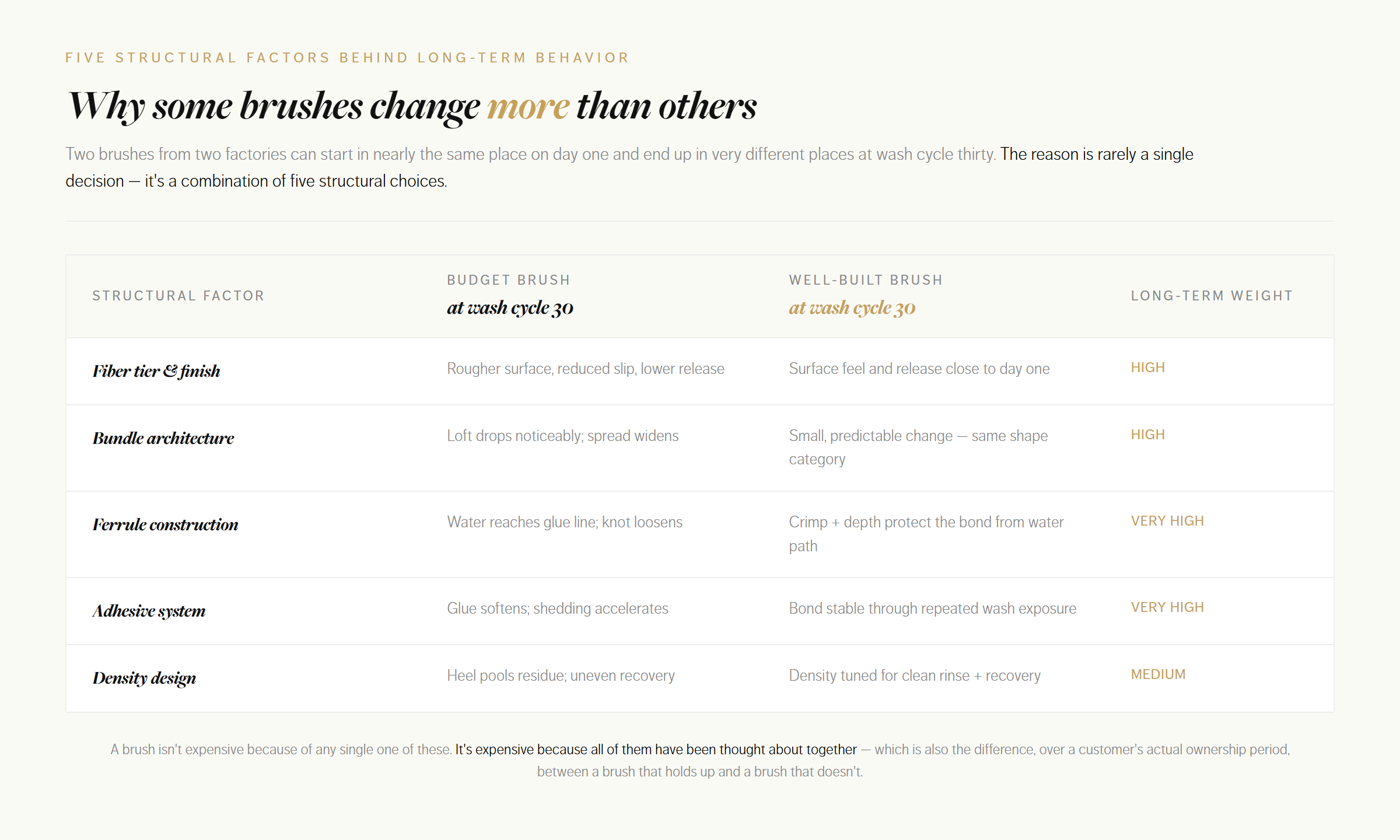
The reason two brushes from the same fiber tier can age very differently is rarely a single decision — it’s the combination of several structural choices made earlier in the build. The factors we usually trace those long-term differences back to:
A brush isn’t expensive because of any single one of these. It’s expensive because all of them have been thought about together. That’s also the difference, over a customer’s actual ownership period, between a brush that holds up and a brush that doesn’t.
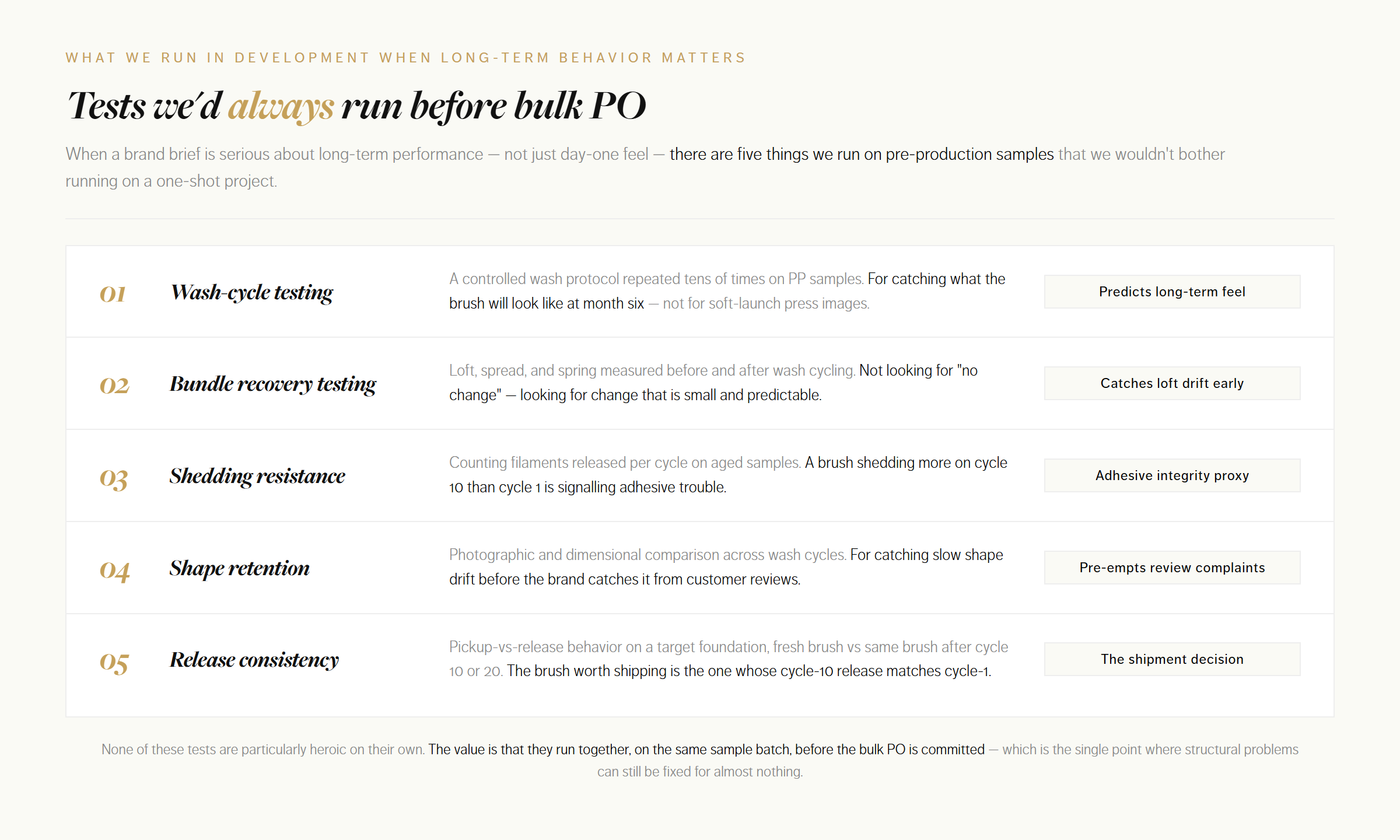
When a brief is serious about long-term performance — not just day-one feel — there’s a handful of things we run in development that we wouldn’t bother with on a one-shot project.
Wash-cycle testing. A controlled wash protocol repeated tens of times on pre-production samples. Not for soft-launch press images — for catching what the brush will look like six months into a customer’s ownership.
Bundle recovery testing. Loft, spread, and spring measured before and after wash cycling. We’re not looking for “no change” — we’re looking for change that’s small and predictable.
Shedding resistance. Counting filaments released per cycle on aged samples. A brush that sheds a little on cycle one and slightly less on cycle ten is healthy. A brush that sheds more on cycle ten is signalling adhesive trouble.
Shape retention. Photographic and dimensional comparison across wash cycles. Useful for catching slow shape drift before the brand catches it from customer reviews.
Release consistency. A practical test: pickup-vs-release behavior on a target foundation, run on a fresh brush and again on the same brush after wash cycle ten or twenty. The brush most worth shipping is the one whose release behavior on cycle ten is close to its release behavior on cycle one.
None of these tests are particularly heroic on their own. The value is that they run together, on the same sample batch, before the bulk PO is committed.
We’ve come to think about this slightly differently than the consumer narrative does.
The goal isn’t to stop a brush from changing. A brush that doesn’t change at all under repeated washing is either brand new or made of something it shouldn’t be made of.
The goal is to make the change controlled and predictable — small enough that the customer doesn’t notice it, and consistent enough that the brush at month six still does what the customer bought it to do.
For OEM development, that means: knowing which parts of the structure will move first, designing around that, and testing for it before the brush leaves the factory.
For brand-care messaging, it means: setting customer expectations that are honest about the difference between a brush that’s settling in and a brush that’s degrading — because most of the after-wash complaints brands receive are actually the first thing, not the second.
Consumers usually judge a brush on day one.
Factories learn more about a brush from wash cycle twenty.
The first application shows how a brush performs. Repeated washing shows how the brush was built — fiber, bundle, ferrule, adhesive — all stacked together and revealed slowly under stress.
The best brushes we ship aren’t the ones that stay identical forever. They’re the ones whose change between cycle one and cycle thirty is small, consistent, and predictable.
If long-term behavior matters as much as day-one feel for your program — retail durability, customer LTV, returns rate — we’re glad to walk through what wash-cycle testing and bundle-recovery checks typically catch before the bulk PO is committed. It’s also one of the decisions behind the construction customers eventually notice.
In most cases, the brush is settling into its actual long-term shape rather than degrading. Shaping sizing rinses out, packaging compression relaxes, and the bundle returns to its loose state – which is often slightly larger and softer than the showroom version.
Some change is normal. Long-term exposure to water and cleansers can slightly alter the fiber surface – especially on lower-tier synthetic fiber. Higher-grade cosmetic PBT or modified PBT tends to hold its surface feel through many more wash cycles.
Often a sign of adhesive stress. Repeated water exposure can gradually soften lower-grade cosmetic glues at the ferrule, leading to knot loosening and progressive shedding. Premium cosmetic-grade adhesives are formulated to resist this.
Yes. In our testing, the same brush dried flat, dried bristle-down, and dried bristle-up over many cycles ends up at slightly different long-term shapes. It’s a structural input, not a neutral one.
