


A factory view on what sample approval actually proves — and what it doesn’t — between an approved prototype and a 5,000-unit production run.
A common brand assumption about OEM brush production goes something like this:
Sample approved → production starts → the same brush arrives.
From the manufacturing side, the actual sequence we see is closer to this:
Sample approved → process validation starts → mass production capability has to be proven separately.
These look like the same thing on a Gantt chart. They’re not. The first version assumes that approving one perfect brush is the same as approving a system that can repeat it. That assumption is where most of the sample-to-production complaints we hear actually trace back to.
This article is about what sits in that gap — and, importantly, what it isn’t.
Before going further, this should be said clearly: samples matter. A lot.
Some industry posts dramatize the sample-vs-production gap by suggesting samples are nearly meaningless — “the sample lies to you.” That isn’t what we see. A weak sample almost never leads to a strong production run. If a sample shows the wrong shape, the wrong density, the wrong pickup behavior — those problems get worse, not better, at scale.
The opposite is also true. A strong sample is usually the first sign that the factory understands the brief. It means the right fiber tier was selected, the bundle architecture was specified correctly, the loft and ferrule decisions were thought through. Without that, nothing downstream of sampling has a chance of working.
So sampling is real. It’s just not where the work ends.
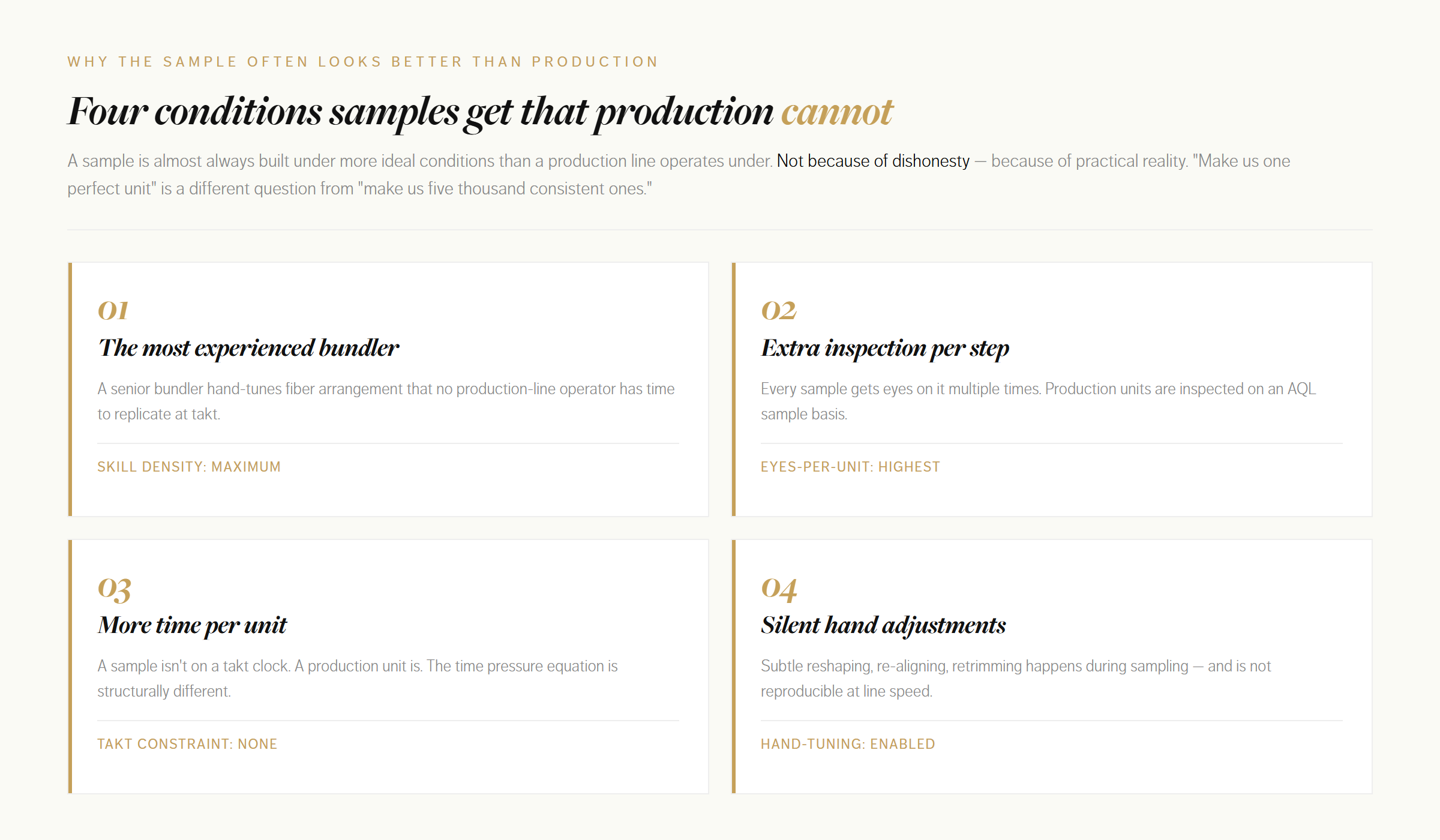
Here’s something most brand briefs don’t account for: a sample is almost always built under more ideal conditions than the production line operates under. Not because of dishonesty. Because of practical reality.
A sample bundle typically gets:
None of this is dishonest. It’s the natural consequence of “make us one perfect unit” being a fundamentally different question than “make us five thousand consistent units.” Brands that don’t account for this difference upfront are often surprised by it later.
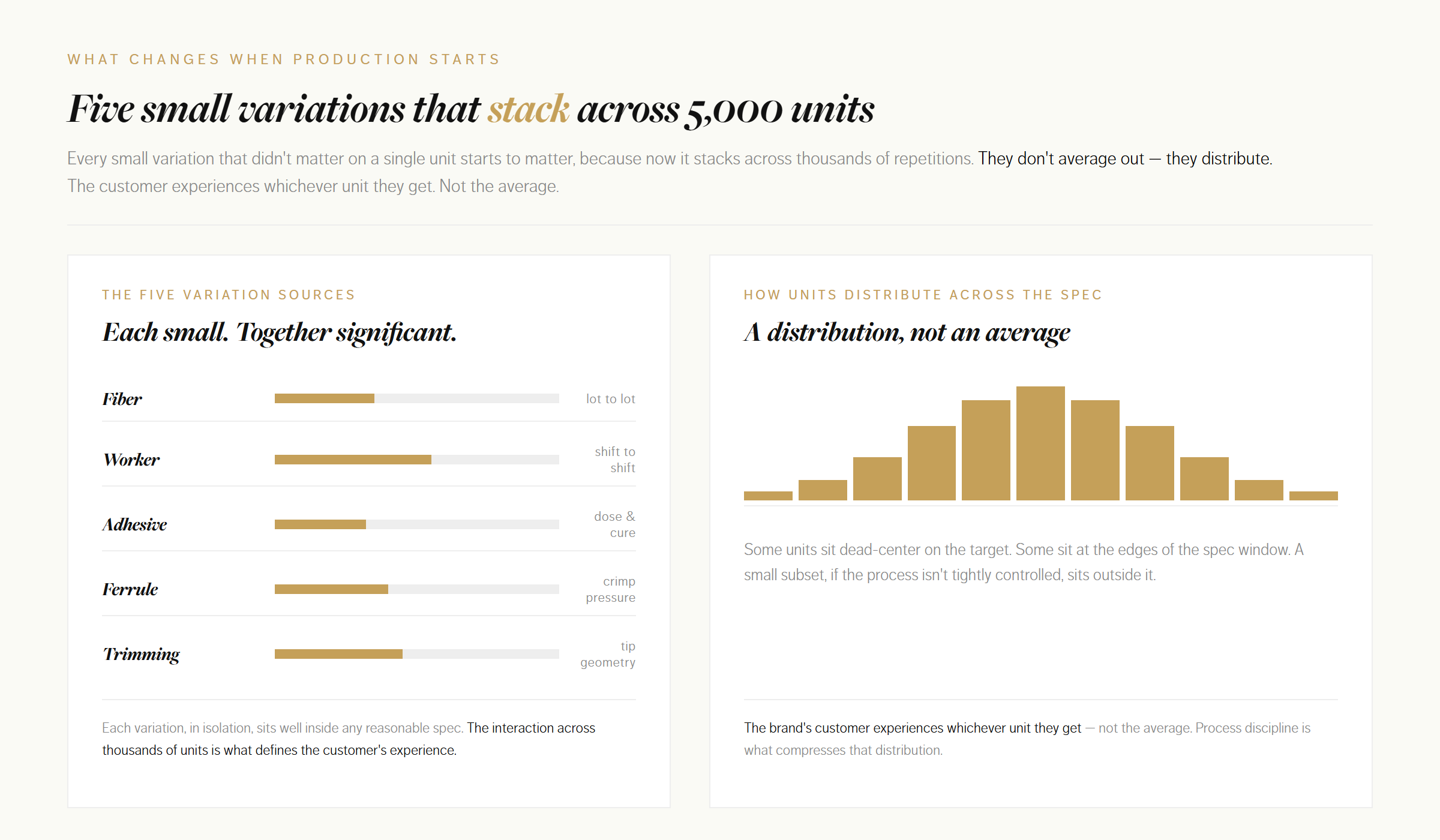
When a brush moves from sampling into a 5,000-unit production run, something subtle but important happens. Every small variation that didn’t matter on a single unit starts to matter — because now it stacks across thousands of repetitions.
The variations that show up at production scale:
Each of these variations is small on its own. Across 5,000 units, they don’t average out — they distribute. Some units sit dead-center on the spec target. Some units sit at the edges. A small subset, if the process isn’t tightly controlled, sits outside.
The brand’s customer experiences whichever unit they get. Not the average.
The most useful reframe we offer brand partners during pre-production review is this:
The right question isn’t “can you make one perfect brush?” It’s “can you make five thousand that behave the same way?”
Those are two very different manufacturing questions. They have very different answers depending on the factory.
A factory that can answer “yes” to the first question and “no” to the second is a factory that can charm a brand through sampling and disappoint them through delivery. We’ve watched it play out often enough to know that the factories consistently delivering bulk orders that look like the approved sample are the ones built around answering the second question first.
That’s where the real OEM evaluation happens. Not at sample approval.
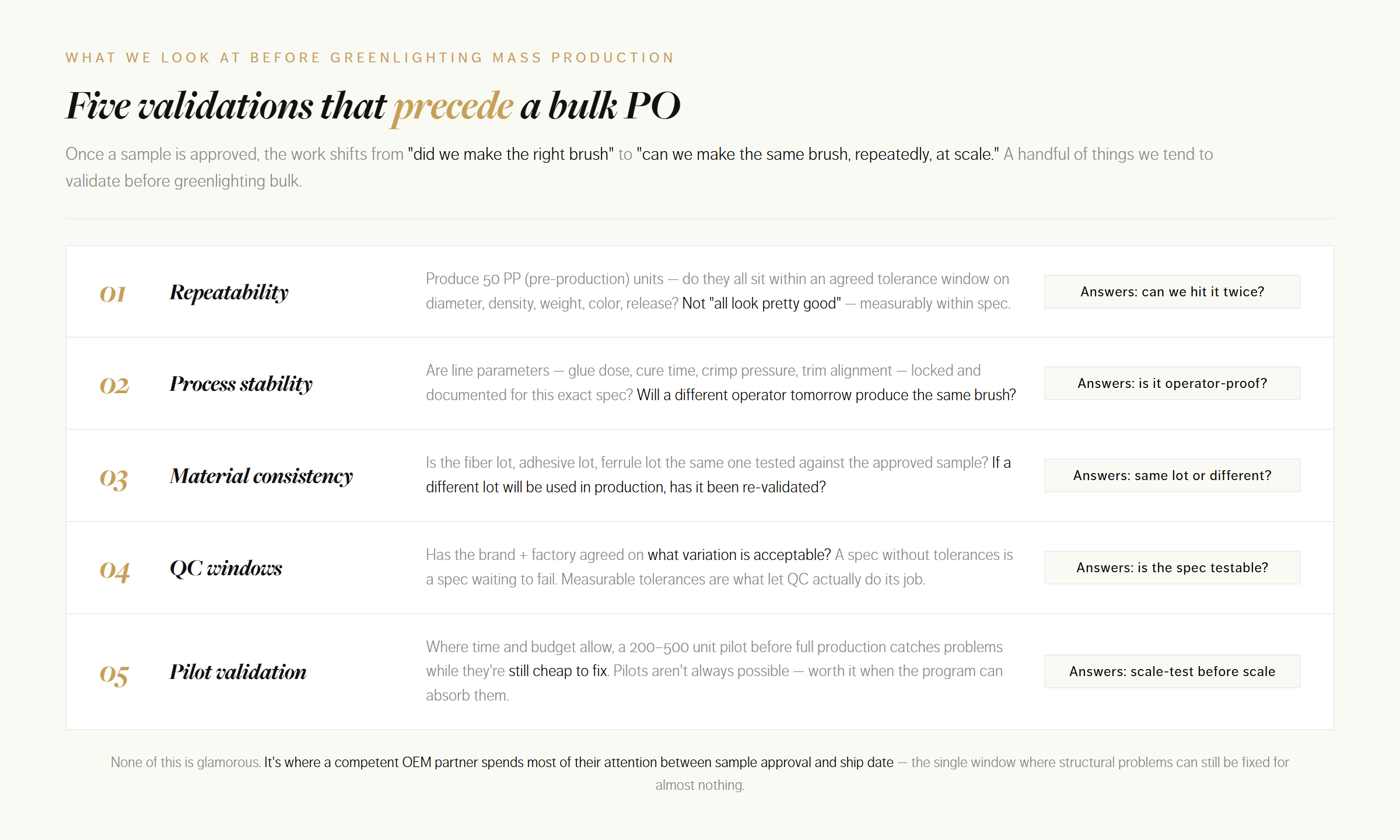
Once a sample is approved, the work shifts from “did we make the right brush” to “can we make the same brush, repeatedly, at scale.” A handful of things we tend to validate before committing to a bulk PO:
Repeatability. Can we produce 50 PP (pre-production) units that all sit within an agreed tolerance window? Not “all look pretty good” — measurably within spec on diameter, density, weight, color, and release behavior.
Process stability. Are our line parameters — glue dose, cure time, crimp pressure, trim alignment — locked and documented for this exact spec? If a different operator runs the same line tomorrow, will they produce the same brush?
Material consistency. Is the fiber lot, adhesive lot, and ferrule lot the same one tested against the approved sample? If a different lot will be used in production, has it been re-validated against the same standard?
QC windows. Has the brand and the factory agreed on what variation is acceptable? A spec without tolerances is a spec waiting to fail. A measurable tolerance window is what lets QC actually do its job.
Pilot validation. Where time and budget allow, running a 200–500 unit pilot before full production catches problems while they’re still cheap to fix. Pilots aren’t always possible, but they’re worth it when the program can absorb them.
None of this is glamorous. It’s also where a competent OEM partner spends most of their attention between sample approval and ship date.
Reducing this risk doesn’t require deep manufacturing expertise on the brand side. A few practical things help:
None of these eliminate sample-to-production variance entirely. They tighten it.
A poor sample is usually a warning sign.
A great sample is usually a good sign.
But neither answers the most important manufacturing question — can the same brush be built consistently, thousands of times, across shifts, across lots, across operators?
Because in manufacturing, quality isn’t proven by the best brush on the table. It’s proven by how closely the next 4,999 brushes resemble it.
If you’re planning a brush program in 2026 — especially a first launch or a major reformulation — we’re glad to walk through what pre-production repeatability validation actually looks like before the bulk PO is committed. The work that happens in that window is often the difference between a launch that ships well and one that ships with surprises.
This is one stage of a larger picture — see the full makeup brush sampling process, from idea to production approval.
No, but a strong sample is the first sign the factory understands the brief. Sample approval proves the design and material choices were right. Production capability – whether five thousand units can be built consistently – is a separate question that gets validated through repeatability checks, process stability, and material consistency between sample lot and production lot.
A sample is usually built under more ideal conditions – the most experienced bundler, extra inspection per step, more time per unit, and hand adjustments that aren’t reproducible at line speed. None of this is dishonest. It’s the natural consequence of making one perfect unit being a different question than making five thousand consistent ones.
A pre-production (PP) sample is built on the actual production line, with the actual fiber lot, adhesive lot, and ferrule lot intended for the bulk run. Unlike an approval sample – which can be hand-tuned by a senior bundler – a PP sample is meant to prove that the production process itself, not just the design, can deliver the approved spec at scale.
The most useful single question is repeatability: can the factory produce 50 PP units that all sit measurably within an agreed tolerance window? Followed by process stability (are line parameters locked), material consistency (same lots tested against the approved sample), and QC windows (are the tolerances actually defined). A pilot order of 200-500 units, where the program allows it, is the most reliable validation step.
