


Brand teams ask one question. The answer is actually two.
When a buyer or procurement lead asks us how long a brush will last, they want a single number. The real answer splits into two completely different conversations.
One is shelf life — how long the brush survives in inventory before quality starts to drift.
The other is user lifetime — how long a customer actually uses the brush before it stops performing.
These two timelines do not move together. A brush with strong shelf life can fail fast in the customer’s hand if the bundle was crimped wrong. A brush with long user lifetime can lose finish quality in a warehouse if the coating wasn’t UV-stable. Brands that treat them as a single number tell their retail buyer one thing, their customers another, and lose alignment somewhere in the middle.

A brand reading this is usually making three decisions in parallel:
Each one runs off a different lifespan number.
The retail buyer wants to know: how long can this SKU sit in the distribution center, on the shelf, in a customer’s drawer before sale, without the brush degrading? That is shelf life — a function of materials, packaging, and storage conditions.
The customer wants to know: once I open this brush and start using it, how long will it actually work? That is user lifetime — a function of fiber memory, crimp stability, wash tolerance, and how the customer actually treats it.
The CEO and the marketing lead want to know: how often will the average customer come back to repurchase? That is replacement cycle — driven by user lifetime, but also by the brand’s care messaging and warranty stance.
Three decisions, three different numbers. The factory side gives you the first two. The third is a brand decision built on top of them.
Factory Note
Most brand briefs we receive ask “how long does the brush last.” Almost none ask “how long does it survive in inventory versus in the customer’s hand.” The brands shipping the cleanest programs treat shelf life and user lifetime as separate spec sheet lines from the kickoff call.
Shelf life is the conversation most brands underestimate.
A finished brush is not chemically inert. It contains an adhesive that ages. A coating that can yellow. Sometimes a wood or natural-fiber component that breathes with humidity. Packaging that absorbs moisture from the air.
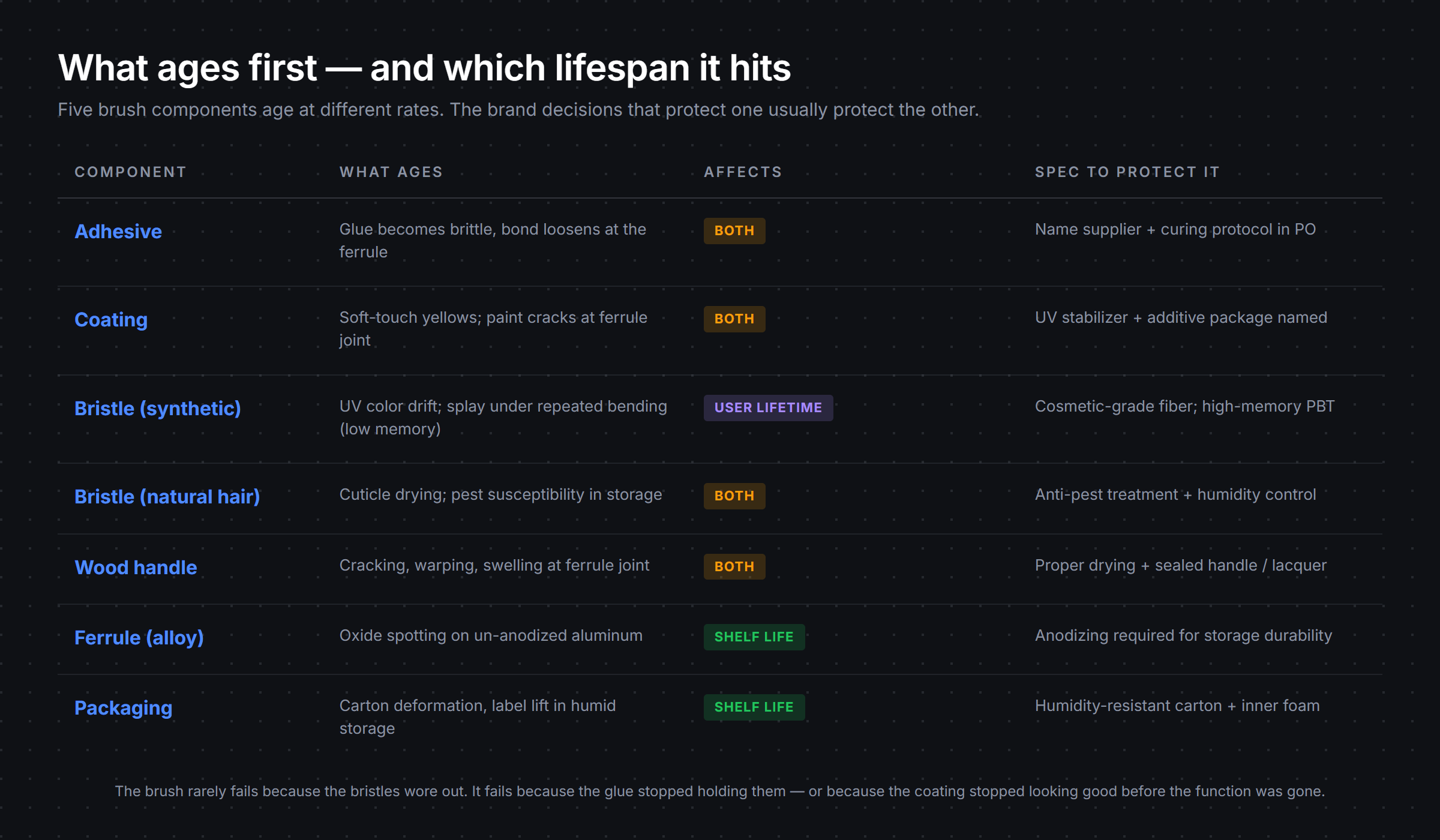
Five components age at different rates.
Bristles. Under normal sealed-storage conditions, cosmetic-grade synthetic fibers (Taklon, PBT, polyester blends) remain dimensionally and visually stable for extended retail cycles. UV exposure over long periods can dull color on lighter fibers. Prolonged humidity can affect feel. Natural hair (goat, squirrel, pony) is more sensitive — it is a biological material and requires pest treatment and humidity control in storage. Brands shipping natural-hair brushes through long retail cycles need to ask their factory what anti-pest protocol is applied at packing.
Adhesive. The glue holding bristles to the ferrule is the most underestimated lifespan factor in the entire brush. Cosmetic-grade adhesives have a usable lifespan that is real but rarely discussed. Lower-grade adhesives tend to become brittle significantly earlier under heat-and-humidity exposure, which increases shedding during long-term use. Premium cosmetic-grade epoxy systems maintain bond stability through repeated wash cycles and extended warehouse storage. The difference shows up not on day one but well into the customer’s ownership window — when a brush that worked fine all year suddenly starts releasing bristles.
Handle coating. Soft-touch coatings yellow without UV stabilizers. Lacquered wood can develop micro-cracks if the wood was not properly dried before coating. Painted aluminum can fade or chalk under long retail-shelf lighting. These are coating-chemistry problems, not brush-design problems — and they are the most common cause of brushes “looking old” before they have been sold.
Ferrule oxidation. Properly anodized aluminum holds visual integrity through extended retail storage. Un-anodized or insufficiently anodized aluminum can develop white oxide spots, especially in humid storage. Copper develops patina over time — sometimes intentional, often uneven.
Packaging. A printed carton in a humid warehouse can deform. Label edges can lift. Inner foam can compress. The packaging often shows aging before the brush inside it does — which affects shelf presentation even when the product is technically fine.
In practice, a properly produced brush in sealed packaging stored under standard retail-warehouse conditions holds its quality for the typical retail cycle a major beauty SKU runs through. Long enough to ship, distribute, sit on shelf, and reach the customer.
The brands that get into trouble are usually the ones who specified the brush for cost without specifying the storage conditions — or whose factory used the cheapest adhesive in the BOM to win the quote.

User lifetime is the conversation most brands over-promise on.
The honest answer is that it depends on the customer almost as much as on the brush.
Three customer profiles run very different lifetimes on the same product.
The light user. Uses the brush a few times a week. Washes monthly. Stores upright in a drawer. A well-made brush in this profile lasts several years before any meaningful degradation.
The daily user. Uses the brush every day. Washes every week or two. Stores in a brush holder or makeup bag. A well-made brush at this profile usually performs cleanly for one to two years, with fiber memory and ferrule integrity holding most of that time.
The aggressive user. Daily use. Hot-water washing. Harsh soap. Stored bristle-side down or in transit through a packed makeup bag. Even a premium brush in this profile starts showing splay and shedding inside the first year.
What ages first on a brush — and this is the question brands almost never ask — is rarely the bristles themselves. The fiber outlasts the assembly.
The failure usually comes from one of three places.
Ferrule shedding. Adhesive aging or under-cured glue lets fibers release at the base. This is the most common end-of-life signal for brushes in the budget tier.
Bristle splay. Lower-memory fibers permanently bend after repeated bending under pressure. The brush still has all its bristles, but they no longer return to shape — which kills pickup and release performance.
Handle finish degradation. Soft-touch coatings turning sticky. Paint flaking at the ferrule joint. Wood handles swelling at the base from wash water. The brush still functions but no longer looks premium.
Most customers think the fibers wore out.
Usually they did not.
What actually failed was the glue line inside the ferrule — or the coating, which stopped looking premium long before the brush stopped working.
Factory Note
The single best engineering decision a brand can make to extend user lifetime is naming the adhesive supplier and curing protocol in the spec sheet. Adhesive shortcuts cost almost nothing per unit at factory level and cost months of user lifetime at customer level. We have seen identical bundles shed at year one versus hold to year three based entirely on which glue was loaded onto the line.
A handful of production decisions drive both shelf life and user lifetime at the same time. A brand specifying these correctly gets both. A brand leaving them blank gets whichever the factory defaults to.
| Decision | Affects shelf life | Affects user lifetime |
|---|---|---|
| Fiber grade (cosmetic vs lower) | Color and feel stability | Resistance to splay and shedding |
| Adhesive supplier and curing protocol | Aging in storage | Bond integrity through washing |
| Ferrule crimp pressure calibration | Pre-sale bundle stability | Years of repeated bending without loosening |
| Handle coating chemistry (UV stabilizer, additive package) | Yellowing / sticky surface over months on shelf | Cracking, chipping under daily use |
| Wood drying and sealing | Cracking / warping in humid storage | Swelling at ferrule joint from wash water |
| Anti-pest treatment (natural hair only) | Storage survival for animal-hair brushes | First-year integrity |
| Packaging humidity barrier | Visual condition at sale | (Indirect) customer expectation framing |
The pattern across this table is simple: the decisions that protect shelf life are usually the same decisions that protect user lifetime. A brand that wins on one usually wins on the other. A brand that cuts corners on one usually fails on both.
The conversation most brands have about lifespan happens at two moments.
First, a sample approval that says “this brush feels great.”
Second, a customer review eighteen months later that says “this brush fell apart.”
There is a third stage in between, and serious OEM programs use it routinely. It is called accelerated aging testing — a controlled lab process that stresses a small batch of pre-production samples to predict how the brush will behave months or years later, before the bulk PO is signed.
A standard accelerated aging protocol for a makeup brush usually runs four parallel tests on a small batch of PP (pre-production) samples.
Humidity chamber testing. Samples sit at elevated humidity for a sustained window — typically several weeks — to simulate distribution-center and retail-shelf exposure. We pull samples on a weekly cadence and check for coating yellowing, adhesive softening at the ferrule, packaging deformation, and any oxidation on un-anodized metal.
UV / light-fade testing. Samples are exposed under controlled UV conditions, referenced against industry-standard accelerated-aging methods such as ASTM D4329 or ISO 4892, to simulate in-store fluorescent lighting and indirect sun. The output is a measurable color-drift number — ΔE against a baseline master — that predicts how the brush will look after months on shelf.
Thermal cycling. Samples cycle between warm and cool conditions repeatedly to stress the adhesive bond and the handle-coating chemistry. Adhesive shortcuts and improperly dried wood usually fail this test first. Coating that yellows quickly under heat usually yellows on shelf, too.
Repeated wash-cycle testing. An automated rig runs sample brushes through tens of wash cycles. Then a ferrule pull test and a shed-bristle count are performed on the aged samples. This is the single most predictive lifespan test we run, because it directly simulates the failure mode that customers actually experience in real use.
The output is a report — not a guarantee.
A serious factory delivers numbers: ΔE drift after UV exposure, shed-bristle count per wash cycle, ferrule pull force on aged samples versus baseline. A brand reads that report and decides whether to release the bulk PO, or to send the spec back for adjustment while tooling and material lots can still be changed.
Factory Note
Six to eight weeks of controlled accelerated-aging exposure can reveal the kinds of degradation patterns that would otherwise appear much later in normal retail and customer-use conditions. The brands that ask for these reports before signing the bulk PO are the brands that do not get caught by long-tail customer complaints once the product is out in market.
The reason most brands skip this step is cost framing, not actual cost.
Lab time on a PP-sample batch is small money against the cost of a defective bulk run, a recalled retail SKU, or a wave of one-star reviews citing shedding. The brands shipping to major retailers run accelerated aging routinely. The brands selling direct-to-consumer often skip it — and learn the same lessons through customer-service tickets later in the product cycle, after replacement and refund costs have already accumulated.
For procurement leads reading this: a written accelerated aging clause in the PO costs almost nothing in negotiation, and it changes the entire conversation when something does go wrong on the production line.
There is a paradox in the budget brush market that brands learn the expensive way. The cheapest brush on a quote sheet is rarely the brush that lasts longest in either lifespan. It is usually the brush that fails fastest in both.
The reason is structural. A factory hitting a low quote price is making savings on the same components that age first: the adhesive, the coating, the fiber grade, the crimp calibration. Each of those savings is small on a per-unit basis. Stacked together, they shorten shelf life by months and user lifetime by a year or more.
A brand selling a $4 retail brush built on $0.40 unit cost is selling a brush engineered to last about as long as the customer expects.
A brand selling a $24 retail brush built on $0.60 unit cost is selling a brush that the customer keeps for three years and tells their friends about.
The unit-cost difference is small. The brand outcome is not.
Not every upgrade earns its place in the BOM. Procurement leads asking “where should our cost premium actually go” usually expect a single answer; the real answer is that some components reward investment far more than others. The four lines below capture how we usually map this on kickoff calls.
Premium adhesive — worth it, almost always. Adhesive is the single most decisive component for both lifespans. The cost difference between a generic glue and a documented cosmetic-grade epoxy is small per unit and decisive deep into the user-ownership window — long after the brand has stopped tracking the production decisions. If the budget allows exactly one upgrade above baseline, this is the one.
UV-stable coating package — worth it for retail-displayed product. A brush sitting under cool LED on a Sephora endcap for nine months is in a different chemistry environment than one shipped direct-to-consumer through dark cartons. For retail-bound SKUs, paying for the UV stabilizer and HALS package is a yellowing insurance policy. For pure DTC programs, the calculus is softer.
Luxury ferrule alloy — often unnecessary. Copper ferrules photograph beautifully and add real per-unit cost. They do not meaningfully extend lifespan over a properly anodized aluminum ferrule in the same crimp calibration. Pay for ferrule color discipline and crimp accuracy, not for the alloy upgrade — unless the alloy is a deliberate brand-world choice rather than a quality assumption.
Ultra-soft coatings — risky long-term. The very softest soft-touch coatings sometimes age the worst. They are more prone to turning sticky, picking up oils, or developing yellow patches under sun and skin contact. A medium-grade soft-touch with the additive package named in the spec usually outperforms a high-grade soft-touch without the additive — and costs less.
The pattern across this list: pay for chemistry and process discipline, not for material upgrades that age the same way the cheaper version does. A procurement team that allocates an extra few cents per unit on the right two components usually gets brushes that age better than brands paying twenty cents more on the wrong three.
For a brand finalizing care card copy, retail spec sheet language, and warranty stance, the practical question is which numbers will hold up to scrutiny.
A reasonable framework for what to claim in writing:
The brands that get this right do not over-promise on either lifespan. They commit to a shelf life that fits the actual retail cycle, a user lifetime that matches the customer profile they actually serve, and a warranty stance that draws a clear line between defect (their fault) and wear (the customer’s care).
For a deeper walkthrough on how these lifespan decisions interact with the rest of an OEM makeup brush program, our private label launch guide covers the spec-sheet-level decisions, and our piece on anodized ferrule color matching goes deeper on the coating-and-finish decisions that drive the cosmetic side of aging.
Across the brush programs we ship, the same lifespan mistakes show up almost every cycle.
Confusing shelf life with user lifetime. A brand tells its retail buyer “two-year shelf life” and tells the customer “lasts for years” — without clarifying which clock is running. The two numbers should be separate lines in the brand’s materials.
Specifying lifespan without specifying the adhesive. Glue is the single most decisive component for both lifespans, and it is almost always left unspecified in brand briefs. Name the supplier and the curing protocol in the PO.
Setting a replacement cycle on the wrong number. Brands building a repurchase email flow off a 12-month assumption sometimes find their customers still using the brush at month 18. Either the lifespan is longer than expected (good for brand love, bad for LTV) or the messaging assumed a worse product than the factory actually shipped. Match the cycle to the real number.
Skipping the care card. A brush without care instructions defaults to whatever habits the customer brings. A brush with three clear care lines — how to wash, how to store, when to replace — measurably extends user lifetime across the customer base.
Treating warranty as marketing. A “lifetime warranty” claim that the brand cannot operationally support becomes a returns nightmare within twelve months. Promise what you can honor. Honor what you promise.
The brands moving smoothly through their second and third year of a brush program treat lifespan as two engineering decisions and two commercial decisions, not as a single marketing claim.
They specify the adhesive in writing. They name the coating supplier. They build shelf-life claims around realistic retail dwell time and user-lifetime claims around the customer profile they actually serve.
When a brush program fails, the problem usually surfaces somewhere between month nine and month eighteen — long after the reorder PO has been placed, long after anyone at the brand still remembers the kickoff call. The brief asked for “long-lasting.” The factory built to whichever default cost least. The brushes aged fine for the first six months and then started shedding, yellowing, or feeling stiff right when the brand stopped paying attention.
In beauty tools, the failure is tied less to misuse than to under-specified aging components inside the original build. The customer experiences the result months after anyone at the brand remembers the kickoff call.
Most custom brush programs we run start with two parallel questions:
Once both numbers are on the table, the engineering decisions stop being guesswork.
The brand programs that ship cleanly through their second and third year usually run an engineering-led kickoff covering four specific scopes:
The output is documentation a brand can take to its retail buyer, its customer care card, and its warranty page — backed by test reports rather than marketing claims.
A brush program built this way rarely needs a “lifetime warranty” promise. It just lasts long enough that customers remember the brand kindly, and short enough that they come back for the next launch.
Most likely the coating yellowed or the carton deformed under warehouse humidity, while the brush itself is still functionally fine. Soft-touch coatings without UV stabilizers, paint on un-anodized aluminum, and printed cartons without humidity barriers all age visually faster than the bristles inside. A properly produced brush in sealed packaging holds quality through a normal retail cycle; the failure is usually in the finish or the packaging, not the brush.
Depends on customer profile. Light users (a few times a week, regular washing, proper storage) get several years from a well-made brush. Daily users typically get one to two years. Aggressive users (hot water, harsh soap, rough storage) often see splay or shedding inside the first year. The brush usually does not fail because the bristles wore out — it fails because the glue stopped holding them.
Almost never the bristles themselves. The most common end-of-life signals are adhesive failure (fibers shedding at the ferrule), permanent splay from low fiber memory (bristles no longer return to shape), and handle finish degradation (sticky soft-touch, paint flaking, wood swelling at the ferrule joint).
A conservative “best within X years from manufacture date” claim that allows buffer for transit and retail dwell time. The realistic durability of a well-made synthetic brush is often longer than the printed claim. Natural-hair brushes need tighter claims because of biological aging. Always set the claim shorter than the engineering allows, not at the edge.
Naming the adhesive supplier and curing protocol in the spec sheet. Adhesive shortcuts cost almost nothing per unit at factory level and cost months of user lifetime at customer level. Identical fiber bundles can shed at year one versus hold to year three based entirely on which glue was loaded onto the line and how it was cured.
Rarely. A lifetime warranty claim that the brand cannot operationally support becomes a returns problem within twelve months. Most premium brush brands offer 30-to-90-day return-or-replace for manufacturing defect, kept clearly separate from natural wear. Promise what you can honor; honor what you promise.
