


Most brand owners walk in thinking a brush program is a purchase order. After eleven years of making brushes, we can tell you it is much closer to designing a small product platform.
We get this question almost every week: “We already source lipstick and skincare. How hard can a brush set be?” Honestly, it is harder than most brand teams expect. It’s also, relative to launching another formula, one of the lowest-risk categories a brand can add — the case for which we lay out in why so many beauty brands add brushes before another formula. When you talk to a custom makeup brush manufacturer about your first program, the conversation is not really about a single SKU — it is about hair, ferrule, handle, finish, and the way those four parts behave together when a human hand picks the brush up.
A lipstick is a formula in a tube. A brush is a feel. The bristle softness, the bend at the ferrule, the weight balance in the palm, the way the logo sits when the brush is rolled — every one of those decisions is its own small engineering choice. When a customer says “this brush feels cheap” they almost never mean the price tag; they mean the handle is too light, or the bristles flare, or the ferrule rocks. That is why we treat a private label makeup brush line less like a stock buy and more like a small product line you and your factory build together — somewhere between full OEM (your spec, our build) and pure private label (our catalog, your logo).
When a brand tells us they want a 12-piece launch set, we usually push back gently. A 12-piece set is a beautiful catalog photo, but it is also twelve molds, twelve bristle blends, twelve QC sheets, and twelve SKUs that have to sell.
For most beauty brands we work with, the right first launch is three to five SKUs. The classic anchor set is a powder or buffing brush, a foundation or complexion brush, and one eye brush — usually a blending or shading shape. You can extend into a setting brush, a contour brush, a fan, or a lip brush in a second drop, once you have real sales data.
Here is a framework we share with brand owners trying to scope their first collection:
This shorter list also makes your MOQ math kinder. Three SKUs at 1,000 units each is a 3,000-unit launch. The same budget across twelve SKUs gets you 250 each, which is below most factories’ minimum and forces you into stock-handle territory whether you wanted to go there or not.

Every custom brush we make sits on four layers, and each layer is its own decision with its own MOQ implications. (We go deeper on how those four layers behave – what each one changes, and which stay reversible after launch – in makeup brush customization options.) Brand teams that understand this upfront design smarter and avoid the “we want everything custom” sticker shock.
Layer 1, brush hair. Natural hair (goat, pony, squirrel) gives one feel; synthetic fibers like soft taklon and ultra-fine PBT blends give another. Synthetic is more consistent batch to batch, vegan-friendly, and easier to color. The bristle blend itself (single fiber vs. blended, tapered tips vs. cut tips) is where most of the perceived quality lives.
Layer 2, ferrule. The metal sleeve that holds the hair to the handle. Aluminum is the standard: light, takes anodized color well, accepts laser engraving. Copper gives a heavier, more premium feel. Plastic ferrules are most often used in cost-sensitive programs. That said, we have seen high-end Korean and Japanese brands use molded plastic ferrules to premium effect — the difference is mold quality, fit tolerance, and finish. Plastic does not automatically read as cheap; sloppy execution does. We worked with an EU indie brand that cut their sampling revisions from four rounds to two by locking the ferrule Pantone before the handle was painted, which removed the cross-component color mismatch we kept catching at QC.
Layer 3, handle. Wood (birch or beech, painted or stained), plastic (ABS, often with a soft-touch coating), or composite. Wood feels warmer and holds matte finishes beautifully but has grain variability. Plastic gives you total color freedom and lower cost.
Layer 4, finish and decoration. Logo printing (pad print, hot stamp, laser), color matching, soft-touch coating, gradient fades, metallic accents. This is where Pantone matching gets real and where most sampling back-and-forth happens.
You do not have to customize every layer. A common smart pattern: customize handle color and logo (the parts customers see), and use a proven hair blend and ferrule shape from our component library. That keeps lead time reasonable and puts your budget into the parts that drive shelf appeal.

We tell brands to budget about four weeks from approved design to a sample they can hold, assuming the design is fully decided when sampling starts. That covers component prep, hair bundling and trimming, assembly, finishing, and buffer for adjustments.
The piece brand teams underestimate is iteration. The first sample is almost never the final sample. Round one goes out, your team uses it for a week, you come back with notes — “too stiff,” “handle is top-heavy,” “logo placement is two millimeters off.” We adjust and send round two. Round three is for fine color matching. The realistic sampling phase is six to eight weeks, not four.
There is no clean public benchmark for sample fees. Different factories charge differently, some refund the fee against your first production order and some do not, and the fee scales with how custom the components are. What we commit to is being explicit about what is included before sampling starts — molds, hair blends, color trials — so there are no surprise line items later.
A brand-side sampling checklist we share:
A typical sampling timeline:
Concept brief → Component spec sheet → Round 1 sample (≈ 2 weeks) → Brand review → Round 2 sample (≈ 2 weeks) → Final approval & PO → Bulk production starts

Pricing math for brushes is more forgiving than for skincare, but it has its own quirks. Factory cost (FOB) lands between a few US dollars for a simple synthetic single brush and the low double digits for a large face brush with premium hair, handle, and full custom finishing. We will not give you a fixed range — every spec changes it, and we have seen brands burned by using a single internet number as a budget.
For DTC pricing, most beauty brands target a gross margin of 70 to 80 percent on brushes. For retail and wholesale, plan for a 50 to 60 percent wholesale discount off retail, plus distributor margin if you go through one. A brush program that only works at full DTC margin will not survive contact with Sephora or Ulta terms.
Design your line with enough margin headroom to survive wholesale, even if you only plan to sell DTC at first. The brands that get stuck are the ones that priced for 75 percent margin and then had to rebuild the spec from scratch when retail showed interest a year later.
Packaging is where the unboxing happens, and on Instagram and TikTok the unboxing is half the brush. We work with brands across three packaging tiers, each with different cost and MOQ implications.
The first tier is a printed paper sleeve or simple folding carton — low MOQ, fast lead time, fine for a single SKU on a marketplace listing. The second tier is a printed gift box with an internal tray for sets — what most brand sets ship in, and it adds real perceived value. The third tier is a rigid magnetic-close box with custom foil, soft-touch lamination, and branded ribbon — premium, slower to produce, and with a meaningful MOQ of its own.
A practical note from the production floor: the packaging MOQ often exceeds the brush MOQ. We can make 500 brushes, but the printer making your gift box usually wants 1,000 or 2,000 minimum. Brands that order boxes separately, late in the process, often find their launch held up by paperboard, not brushes. Order packaging the same day you sign off on the production order, and have the dieline finalized before sampling closes.
This is the question we get asked first and answer with the most “it depends.” There is no clean industry-wide number for makeup brush MOQ. Most factories doing meaningful customization have a per-SKU minimum in the few-hundred to low-thousands range, and the more customization you stack, the higher the floor goes.
A fully custom handle needs more units to amortize the mold cost. A custom-printed handle on a stock shape needs far fewer. A custom hair blend needs more, because we mix and dedicate a hair lot to your spec. This is why we keep an in-house component library — brand teams not yet at full-custom volume can mix stock components with custom finishing and get the per-SKU floor down considerably.
A Korean K-beauty brand initially asked for twelve SKUs at 800 units each. We walked them through the math and they relaunched with three SKUs at 3,500 units each — fewer molds, better margin, and a cleaner sell-through story to their retail buyer.
For lead time on a real production run after samples are approved:
QC for brushes happens in three places, and we run all three inside our own makeup brush factory. First is incoming inspection — when hair, ferrules, handles, and packaging arrive, each is checked against spec before it goes near assembly. Second is in-process inspection — at the bundling station, at the crimping station, after handle painting, after logo printing. We pull samples at each step and check against the approved master sample.
Third is final-product inspection. We use AQL sampling to pull a representative sample from the finished lot, and check bristle shed, ferrule alignment, handle straightness, logo placement, color match against the approved Pantone, and packaging integrity. The lot is graded by defect count and either passes, gets reworked, or gets pulled. On a US Amazon-FBA seller’s first run, our final-product inspection caught a 6% bristle-flare rate from a single sub-lot of bristle and we re-bundled before shipment. The replacement rate post-launch was below 0.5%.
A point of factory color: anodized aluminum ferrules in the same Pantone from two different anodizing baths can read visibly different side by side. We catch this in batch matching — we lay out ferrules from sequential baths under standard lighting and reject the ones that drift outside tolerance. It is the difference between a clean retail row and one where customers can see the variance from across the aisle.
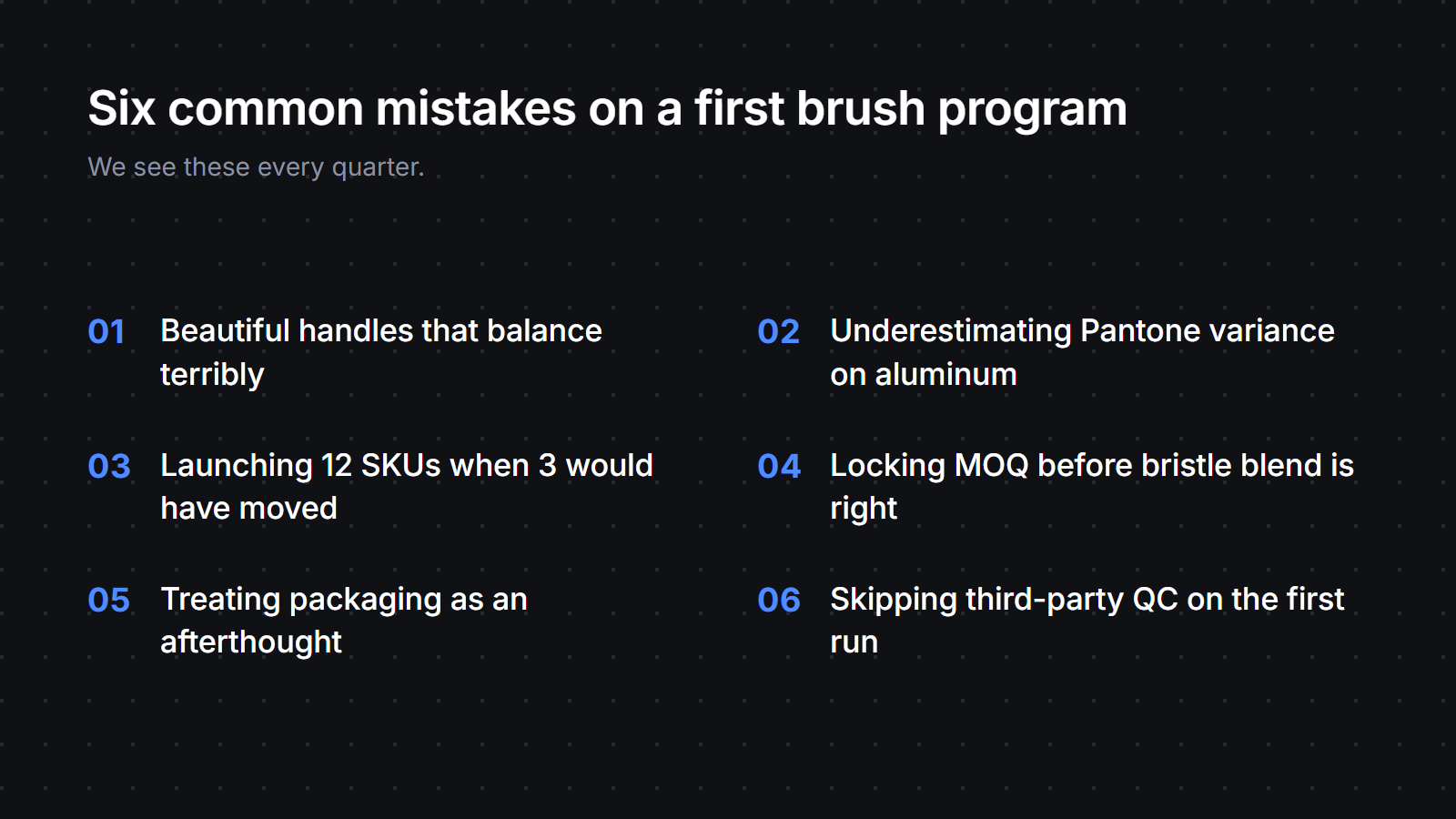
After eleven years and a lot of first-time brush programs, the same handful of mistakes show up over and over. Calling them out plainly here is faster than learning them the expensive way.
The full launch playbook
Every decision on this page has its own in-depth guide. Work through them by stage:
Decide the category & format — why add brushes at all · custom vs stock · set vs single · standalone line or part of the collection
Design & customize — what to customize first · private label vs fully custom · where premium feel comes from · what decides quality
Cost & quantity — what a launch costs · how to read a quote · MOQ explained · why similar brushes cost differently
Sampling → production — the sampling process · feedback that moves a sample · lead time, day by day
Packaging & compliance — product or packaging first · custom packaging & its lead time · FDA & MoCRA
Start the conversation — what to send in an OEM brief
We recommend three to five SKUs for a first launch, not twelve. The right anchor set is usually one hero face brush that defines your softness and bristle character, one functional second face brush (foundation or contour), and one universal eye shape (blending, packing, or smudging). Twelve SKUs is a beautiful catalog photo, but it is also twelve molds, twelve bristle blends, twelve QC sheets, and twelve SKUs that have to sell. Three SKUs at higher per-SKU runs gives you better margins, faster sell-through data, and the option to expand into a planned Drop 2 once you know what is moving.
There is no clean public benchmark — brush MOQ depends on which of the four customization layers you change. Reusing a stocked handle and only swapping print or bristle blend keeps per-SKU minimums in the few-hundred range. Adding a custom anodized ferrule color, a new bristle blend, or a fully custom handle mold pushes per-SKU MOQs into the low thousands and adds a one-time mold or tooling fee. In our factory the practical answer is: pick which layers actually need to be custom for your brand, and let your factory size MOQ around that decision. How brands weigh those layers – private label, semi-custom, or fully custom – is a decision we have looked at separately in private label vs fully custom. Anyone who quotes a flat MOQ before seeing your spec is guessing.
Plan four to eight weeks for sampling, depending on how much customization you stack. Round one usually takes about two weeks from sign-off on the spec sheet — that gets you a physical brush you can hold. Almost every project goes to round two for either bristle blend, ferrule color, or handle weight adjustments. Round two is another two weeks. If you are adding new tooling (custom handle mold, new ferrule extrusion), add another three to six weeks for the tooling itself before round one even starts. Brands that lock the ferrule Pantone before the handle is painted typically cut total revisions from four rounds to two.
We usually steer new brands to high-quality synthetic blends. Synthetic fiber (soft taklon, ultra-fine PBT) is more consistent batch to batch, vegan-friendly, easier to color-match, and increasingly the default in premium brand lines. Natural hair (goat, pony, squirrel) gives a softer, denser feel that some traditionalist brands still prefer, but it is harder to source consistently and faces growing consumer resistance on cruelty-free grounds. For a first-time brand launch, the bristle blend itself — single fiber vs blended, tapered tips vs cut tips — usually drives perceived quality more than the natural-vs-synthetic choice.
