


Most people think the leading beauty brands choose the factory on price. They choose them on something else entirely.
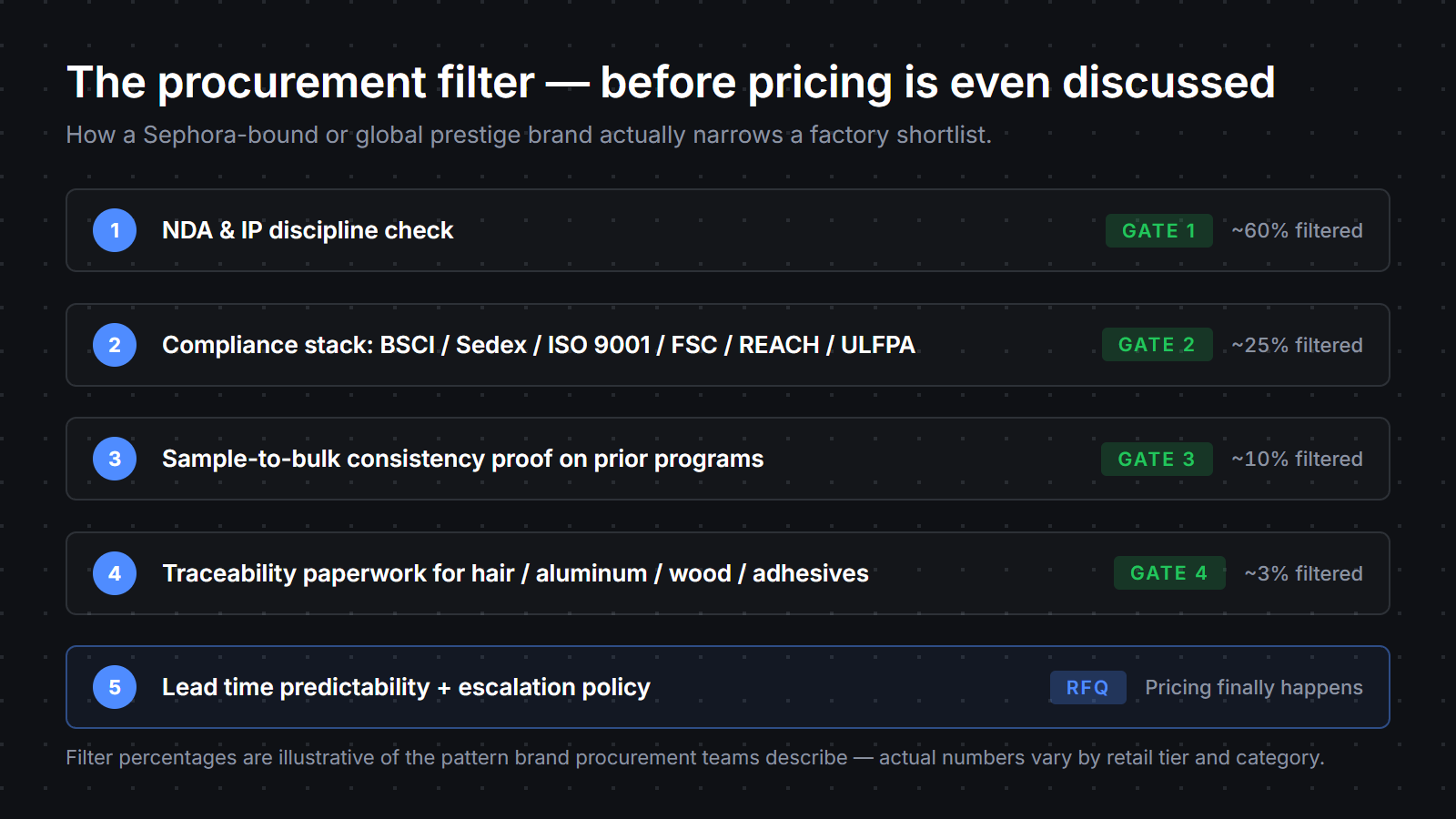
Aspiring beauty brands tend to negotiate the wrong things first.
They open a kickoff call with unit price. They push on MOQ. They ask whether a logo can be hot-stamped instead of laser-etched. Useful questions, all of them — but not the questions a leading beauty brand is asking on the same call.
Brands operating at the top of the market have already filtered most factories out before pricing is on the table. Their procurement teams work from a checklist that has nothing to do with cost per piece. If you cannot pass it, you do not get to quote.
This article is what that checklist actually looks like, written from inside an OEM makeup brush factory that has shipped under names international retailers recognize. Read it as a forward indicator. The standards major brands enforce today are the standards your retail buyer will enforce on you in two years.
Leading beauty brands almost never open with “send us your catalog.” They have their own R&D pipeline, their own design language, and a clear brand direction — they are not shopping for inspiration from other people’s work. What they want to know is whether your factory can actually execute against their vision.
The conversation typically opens with a mutual NDA and a small, targeted brief: a specific sample challenge built around their next launch. It is a deliberate test. Can you read a spec correctly? Can you suggest substrate or component changes that improve the design without rewriting it? Can you turn a credible first sample inside the timeline you quoted?
Factory Note
Leading brands rarely ask “what have you made for other people.” They ask “here is what we are trying to build — show us a sample that proves you understand the brief.” That single sampling round is the most honest read of a factory’s R&D and translation capability. The factories that nail it get to round two. The ones that produce something off-brief or off-quality usually do not.
Two filters do most of the elimination work at this stage. The first is R&D depth: can the factory translate a brand’s design language — bristle feel, handle silhouette, finish — into a sample that actually matches the brand world. The second is production stability: can the factory hold that quality across the second, third, and tenth reorder without the spec quietly drifting. Both filters expose the same underlying gaps. Thin R&D bench. Narrow component library. Inconsistent QC discipline. Opaque escalation when something on the line slips.
The IP discipline conversation runs in parallel from day one. Mutual NDA before any sample work. Clear answers on how project information is partitioned inside the factory. Many prestige programs request stricter separation between active projects during sampling and assembly, especially for confidential launches. We color-code active projects on the production floor so any program is visually traceable from across the room, and so no sample ever moves into the wrong assembly zone.
For a brand at any size, the test is simple. Send your custom makeup brush manufacturer a small but specific design challenge — a particular bristle feel, a particular handle shape, a specific Pantone — and watch how they handle the first sample round and the questions around it. Factories with real R&D and production discipline answer fast and propose intelligently. Factories without it will improvise, and the cost of that improvisation usually shows up around the second reorder.

A second tier of factories will get past the NDA conversation. Almost all of them will lose the next one.
Brands operating at this level expect a compliance stack that proves three things on paper: the factory passes ethical social audits, the materials trace cleanly to compliant sources, and the production line meets the regulatory standards of the destination market. The names you will see in their RFQs are well-known. The places brands actually get blocked are less obvious.
| Audit / certification | What it verifies | Where most factories fail |
|---|---|---|
| BSCI / Sedex SMETA | Social and labor compliance | Expired audit date — re-certification cycle missed |
| ISO 9001 | Quality management system | Scope of certificate does not include the actual production facility |
| FSC | Wood handle chain of custody | Missing documentation on secondary suppliers (handle blanks, finishing) |
| REACH | EU restricted chemicals | Adhesive or coating supplier cannot produce current SDS |
| ULFPA traceability | US import legality | Raw-material supplier unwilling to disclose origin region |
| SGS / TÜV / Intertek audits | Third-party inspection | Factory refuses brand-booked inspection on the actual production line |
A factory that holds anodized aluminum capability and a beautiful component library but cannot produce a current Sedex audit report for the exact facility making your product is simply not in the conversation for a Sephora launch.
The practical read for brands scaling: do not get impressed by certification logos on a factory’s homepage. Ask for the report numbers, the audit dates, and the facility named in the report. Major brand procurement teams ask all three on the first call.
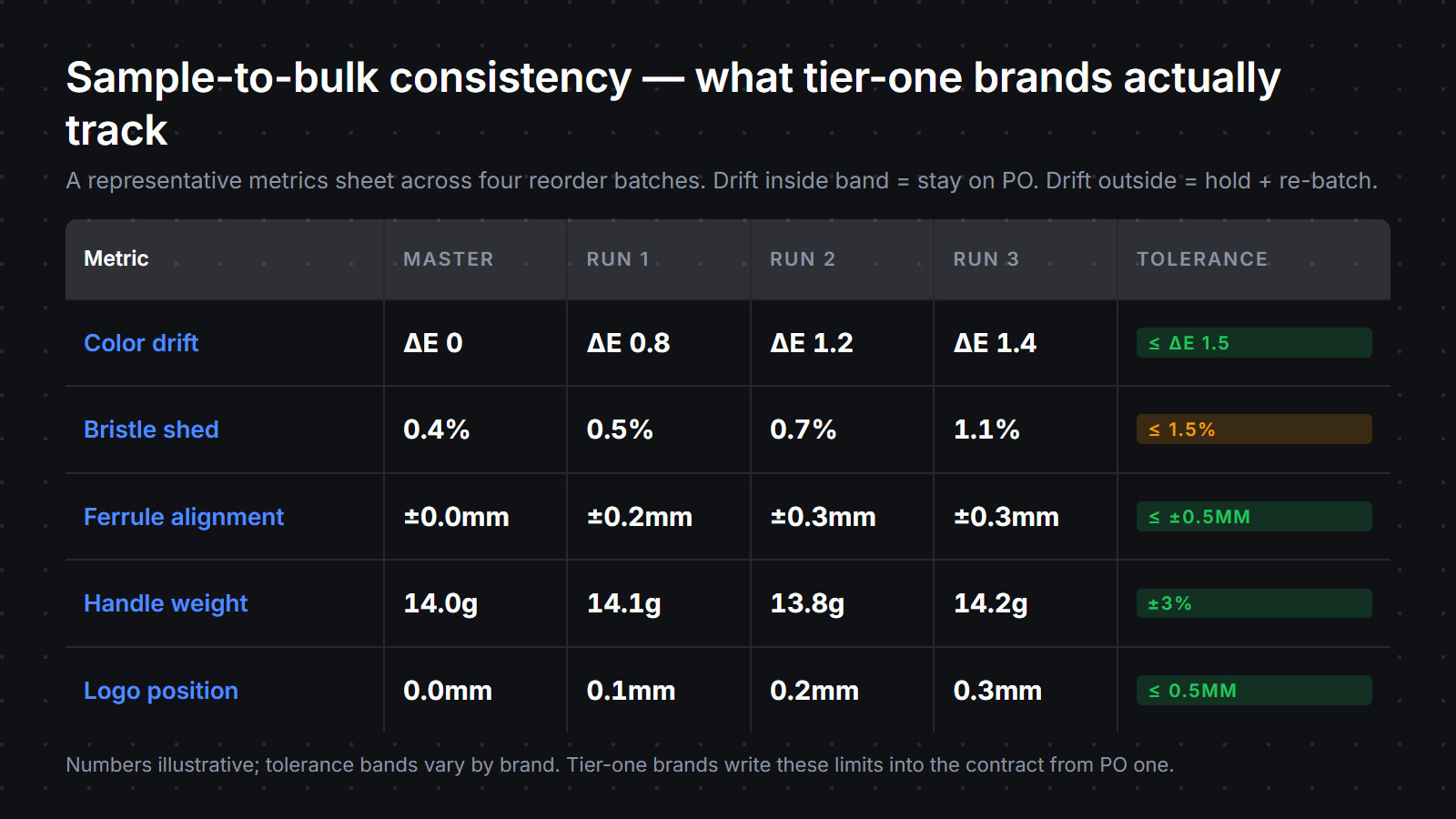
We have seen brands approve a perfect first sample in February, launch successfully in June, then reject half a reorder batch in September because the ferrule tone drifted under Sephora’s retail lighting.
That is the real production test. Not the first sample. The second reorder.
A beautiful prototype is easy. Most factories can hand-finish something that photographs well and feels right. The hard problem is producing the same brush — same softness, same ferrule alignment, same color — five thousand times in March and another five thousand when the brand reorders in September.
Major brand procurement teams track this with measurable indicators across every production batch:
Several prestige programs we support require approved master samples to be archived for future reorder verification, with serial numbers logged so an auditor can physically compare a current production unit against the original master at any point in the contract. That is the level of evidence the relationship is built on.
In beauty tools, the trend color rarely fails on the moodboard. It fails in repeat production. The factories that earn reorders at this level are the ones whose systems can hold the spec across three years of seasonal launches — not just one beautiful sample.
A pattern we see often: a brand approves a sample, runs a clean first launch, then receives a sustainability questionnaire from a retail buyer three months later asking where every component actually came from.
Traceability is no longer a value-add for brands at this scale. It is an after-launch survival requirement.
The components brands now expect to trace cleanly:
Natural hair. Goat, pony, squirrel — animal welfare scrutiny is increasing fast. Brands want documented sourcing, not “ethically sourced” on a label.
Synthetic fibers. Vegan claims have to survive third-party audit. PBT and Taklon recycled-content percentages must be supported by supplier documentation.
Aluminum. Recycled content claims need mill certificates. US-destined product also needs proof the bauxite supply chain does not touch ULFPA-flagged regions.
Wood. FSC chain-of-custody from forest to finished handle. Brands without FSC paperwork now lose shelf placement in major European retailers.
Adhesives. REACH compliance for EU; California Prop 65 for US; specific glue chemistries flagged for cosmetic-adjacent use.
For a brand reading this: do not let your custom makeup brush manufacturer tell you traceability is sorted by the certificate on the wall. Ask for the specific supplier chain documents for the specific batch you are about to receive.
Procurement directors do not get fired for choosing the slightly more expensive factory.
They get fired when a launch misses shelf date.
That single sentence explains why major brand procurement teams will tell you, off the record, that they would rather work with a factory that ships in 60 days on date than one that promises 30 days and shows up on day 45. Retail slots at Sephora, Ulta, or Boots are calendared nine months in advance. A SKU that misses its launch window misses the season. A brand that misses a season at a major retailer often loses the next year’s slot.
What brands at this scale actually want to see in lead time discipline:
Factory Note
We add four to seven calendar days of buffer to every quoted lead time for a major brand program. The buffer is not for us — it is for the brand. They would rather hear “we will ship on April 22” and receive on April 18 than hear “we will ship on April 15” and receive on April 24.
Not every brand reading this should be optimizing for the full enterprise-grade checklist on day one. The procurement priorities scale with the brand.
Indie brands (pre-retail, sub-$1M revenue) care most about MOQ flexibility, fast sampling, and packaging flex. They want a factory that will take a 500-unit run, turn samples in three weeks, and let them iterate on packaging without a tooling fee. Compliance documents matter, but the audit conversation usually has not started yet.
Retail-entering brands (Sephora-bound, $1–50M) care most about sample-to-bulk consistency, retailer audit readiness, and traceability paperwork. They have just landed a wholesale account and discovered that their retail buyer wants Sedex reports and chain-of-custody documents they did not previously think about. The factory that can produce these on the first request — without panic — wins the renewal.
Global brands and conglomerate-owned lines ($50M+) care most about legal exposure, ESG scoring across their full supplier base, and supplier redundancy. They have a procurement department, an in-house ESG team, and a legal team that runs sanctions screening on every supply node. The factory’s job at this tier is to feed clean data into their reporting systems and to maintain capacity even when one of their three other suppliers misses a quarter.
A factory built for one tier is rarely fluent in another. The OEM makeup brush factory that does well with indie brands often cannot pass an enterprise onboarding. The factory built for enterprise programs often cannot quote a 500-unit indie program profitably. Pick a partner whose installed base actually matches where you want to be in three years, not just where you are today.
A short playbook from working with brands at different growth stages.
If you are a clean-beauty startup planning your first thousand units, you do not need to meet every Sephora-tier requirement yet. But you should already be asking your factory the questions that brand will ask in two years:
If the answers come back concrete, specific, and ready, you have found a partner who can scale with you. If they are vague or improvised, you have found a factory who will be replaced before your second year at a major retailer.
The factories that have done OEM and private label work for international brands already operate at this standard whether the current brief calls for it or not. The standards do not get easier as you grow. They get enforced harder.
What we are seeing across the projects on our floor right now: the gap between brands that scale and brands that stall is almost never about product design. It is about which questions they thought to ask their factory before signing the first PO.
The brands shipping under names leading retailers stock have rehearsed this conversation. They know exactly which audit reports to ask for, which traceability documents to request, which consistency metrics to write into the contract. Their procurement teams are not nicer than emerging-brand teams. They are more specific.
The factories the world’s leading beauty brands trust are usually not the factories with the cheapest quote or the loudest showroom. They are the factories whose systems still hold together after the third reorder, the second audit, and the first delayed shipment.
That is the level procurement teams are actually buying.
BSCI or Sedex SMETA social audits, ISO 9001 quality management, FSC chain-of-custody for wood handles, REACH for EU SKUs, and third-party inspection capability from SGS, TÜV, or Intertek. US-bound product also requires ULFPA traceability. Procurement teams ask for report numbers, audit dates, and the named facility — not certificate logos.
Because confidentiality is part of supplier qualification. Leading brands want to know where competitor samples are stored, who has access, and how IP is protected during production. Factories that have not rehearsed those answers are filtered out before pricing is discussed.
It means reproducing the same brush — softness, color, ferrule alignment, weight, logo placement — across reorders months or years apart. Brand procurement teams track color drift, bristle shed rate after wash cycle three, and ferrule alignment on samples pulled from every fifth carton in the export run.
Hair provenance (animal welfare for natural hair, vegan certification for synthetics), aluminum mill certificates with recycled content claims, FSC chain-of-custody for wood handles, and REACH or California Prop 65 compliance for adhesives. Always ask for documents tied to the specific batch, not a generic certificate on the wall.
Because retail slots at Sephora, Ulta, or Boots are calendared nine months in advance. A SKU that misses its launch window misses the season — and brands that miss launches often lose shelf placement the following year. Procurement teams prefer 60 days on date over 30 days that slips to 45.
