


A factory-side breakdown of what it typically costs to launch a custom makeup brush brand — and the budget decisions that quietly drive total cost higher than MOQ alone.
If you’re still weighing whether brushes are the right category to add at all, we make the broader case in why so many beauty brands add brushes before another formula. Most first-time beauty brands launching a custom makeup brush line invest somewhere between $3,000 and $15,000 before the first unit reaches customers. The final cost depends on MOQ, brush specifications, packaging complexity, sample development, compliance requirements, and freight strategy. For simple 500-set launches using existing brush designs, total investment can start around $2,000–$8,000 — while retail-ready programs with custom tooling and premium packaging typically run $25,000+.
Most first-time beauty founders expect a custom makeup brush line to work the way ordering finished product from a catalog works: choose a design, add a logo, place an order, launch.
From a factory floor, that mental model breaks down quickly. Most of the budget doesn’t come from the logo — it comes from a sequence of decisions made much earlier: brush construction, packaging tier, MOQ band, sample-round count, and logistics. None of those decisions are visible from a product page, but each one moves the makeup brush startup cost for a beauty brand by hundreds — sometimes thousands — of dollars.
That’s why two custom makeup brush programs at the same order quantity can end up costing dramatically different amounts. Before going deeper into the breakdown, here’s the quick answer most readers are actually looking for.
Why these numbers matter. The makeup brush startup cost ranges in this article are based on custom brush programs manufactured through Meet Cosmetics, a Guangdong-based makeup brush factory serving beauty brands in more than 40 countries. Our facility operates under ISO 9001 quality management, with BSCI-audited production processes, FSC-certified packaging options, SGS-tested material batches, and REACH-compliant material sourcing. The patterns and budget ranges below come from direct floor-side experience — not from secondhand industry reporting.
A note on scope. The budget ranges below focus on manufacturing-related launch costs — sampling, production, packaging, compliance, and freight. Brand-building expenses such as advertising, website development, photography, trademark registration, and customer acquisition are not included, because they vary significantly by business model and market strategy. The numbers here are what a brand pays the factory side of the supply chain; the brand-marketing side is a separate budget.
| Brand stage | Typical MOQ | Typical budget |
|---|---|---|
| Test launch | 500 sets | $2,000–$8,000 |
| Indie brand | 1,000–3,000 sets | $8,000–$25,000 |
| Retail-ready | 5,000+ sets | $25,000–$100,000+ |
One-sentence answer: most first-time custom makeup brush programs land somewhere between $3,000 and $15,000, depending on customization depth, packaging tier, and freight method. Across the first-launch projects we’ve handled in the past two years, the large majority have landed inside this band.
For founders who want the per-line numbers behind the totals above, here’s a typical range for each major cost line on a custom makeup brush startup program:
| Line item | Cost type | Typical range |
|---|---|---|
| Sample development (per brush) | Fixed | $100–500 |
| Custom logo design / artwork | Fixed | $50–300 |
| Custom handle mold tooling (if used) | Fixed (per design) | $1,500–5,000 |
| Brush production (per unit) | Per unit | $0.50–10.00 |
| Custom brush packaging (per unit) | Per unit | $0.10–5.00 |
| Freight (sea → air) | Per order | $500–5,000 |
| Compliance & testing (Prop 65, REACH, etc.) | Fixed | $100–2,000 |
The numbers above are typical observed ranges across recent private label makeup brush programs we’ve shipped. The biggest per-unit range — $0.50 to $10.00 per brush — covers the gap between standard cosmetic-grade PBT in a simple plastic handle and Toray-grade fiber in a custom-tooled premium handle. The biggest fixed line — custom makeup brush mold cost — is also the one most first-time brands defer to launch two, since tooling is the line item that locks design before the brand has market signal.
The rest of this article is about how these line items combine into a realistic total, and which ones to prioritize when the budget is tight.
Planning your first brush launch?
Not sure which budget tier fits your brand? Send us your target retail price, planned MOQ, sales channel, and launch timeline — our product team will provide a preliminary budget assessment before any sampling begins. No commitment to move forward required.
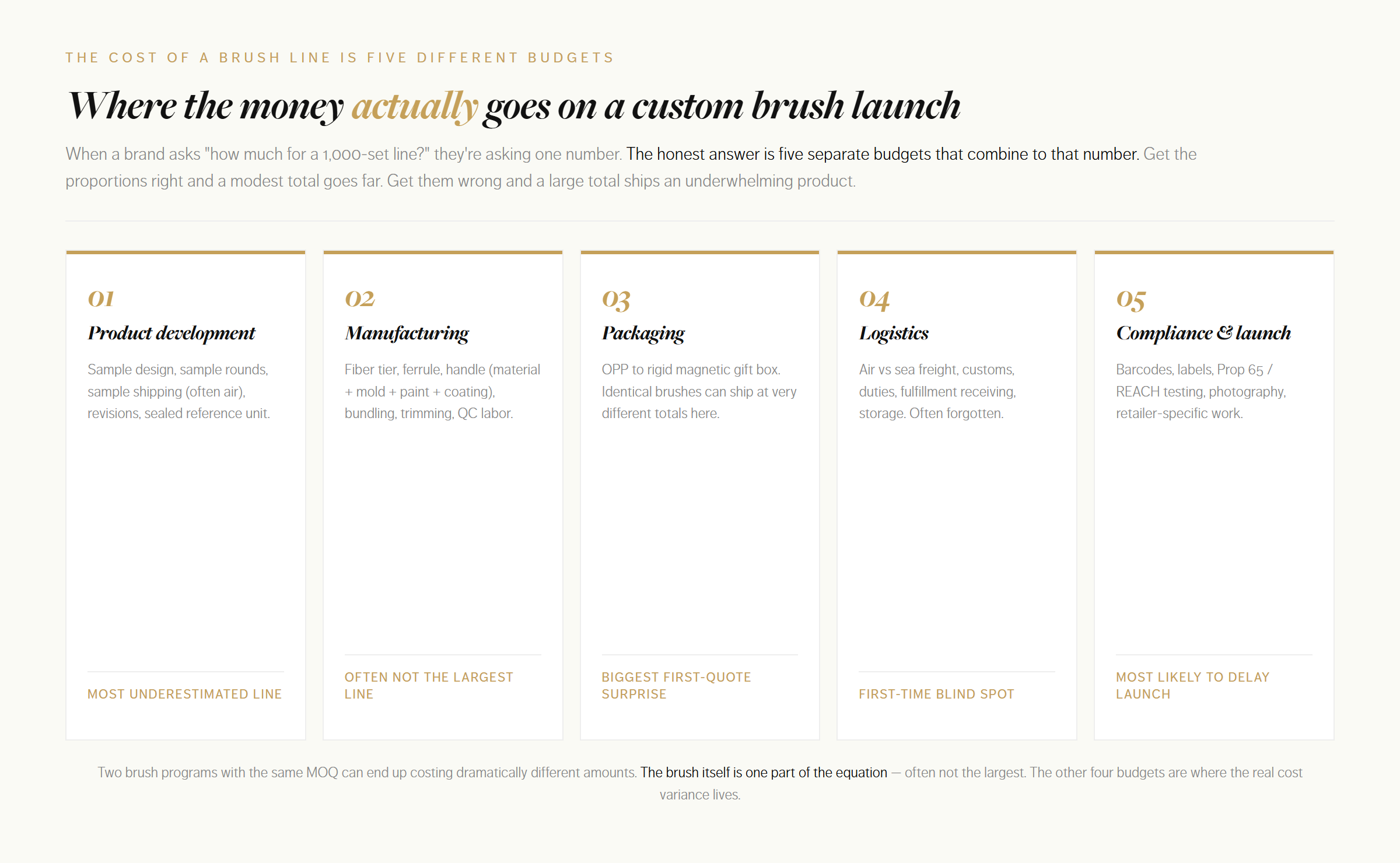
When a brand asks us “how much for a 1,000-set custom brush line?” — they’re asking one number. The honest answer is usually five separate budgets that combine to that number. Get the proportions right, and a modest total goes further than expected.
Sample design, multiple sample rounds, sample shipping (often air freight from China), revisions between rounds, and a sealed reference unit. One of the most underestimated lines on a first launch.
A project approved in the first sampling round costs less than one that goes through three or four rounds. The fastest-launching brands we work with arrive with a clear creative brief and respond to sample feedback within days, not weeks.
This is the line most brands focus on, and the line most brands have wrong assumptions about. The makeup brush manufacturing cost includes:
A quick note on fiber tier, because most first-time brands ask: standard cosmetic-grade PBT performs very well for most applications, including the synthetic brushes inside the majority of mass-tier launches. Premium-grade fibers such as Toray typically offer tighter diameter control, softer tips, and better long-term consistency cycle-to-cycle — which is why some brands choose them when those properties matter to the brand story. Fiber selection should ultimately align with brand positioning, target retail price, and performance goals.
The brush itself is usually only one part — and often not the largest part — of the total cosmetic brush production cost. A premium ferrule + handle combination can easily cost as much as the bristle bundle inside it. For private label makeup brush programs in particular, the brush-vs-handle cost split is the first place a brand can pull a meaningful lever without compromising on customer-facing quality.
The line most likely to surprise a brand on the first quote. Custom brush packaging cost spans an extreme range. (Packaging runs on its own supply chain and clock, which we break down in custom makeup brush packaging.)
A simple OPP bag costs almost nothing per unit. A rigid magnetic-closure gift box can cost several times what the brush inside costs. A concrete example from a recent gift-set program we shipped:
| Line item | Per-unit cost |
|---|---|
| Brush itself | ~$2.50 |
| Magnetic-closure outer box | ~$3.80 |
| Foam insert (custom-cut) | ~$0.60 |
| Printed outer sleeve | ~$0.40 |
| Total packaging | ~$4.80 |
| Total brush | ~$2.50 |
Packaging at roughly 1.9x the brush itself. The customer pays for what they see. The brand pays for what they spec.
This pattern surprises many first-time founders because consumers assume they are paying for the brush itself. In reality, premium beauty products frequently carry more packaging cost than tool cost — it’s part of what funds the perceived prestige of the category.
Where the custom brush packaging cost hits hardest is when packaging is decided late — after the brush spec is locked, after the sample is approved, sometimes after the bulk PO is placed.
Air freight vs sea freight is the single largest variable here. A 1,000-set program shipped by air to North America or Europe can pay several thousand dollars more than the same program shipped by sea — but air buys 4–6 weeks of lead time back, which can be the difference between making a launch window or missing it.
On top of freight: customs, duties, fulfillment-center receiving fees, and storage costs. First-time brands often forget to budget this entirely.
Barcodes (GS1 registration), labels in the correct languages, market-specific test reports (California Prop 65 for the US, REACH for the EU), product photography, and retailer-specific compliance (Sephora, Ulta, mass-market each carry their own standards).
This line is usually small on a percentage basis. It’s also the line most likely to delay launch when it’s been ignored.
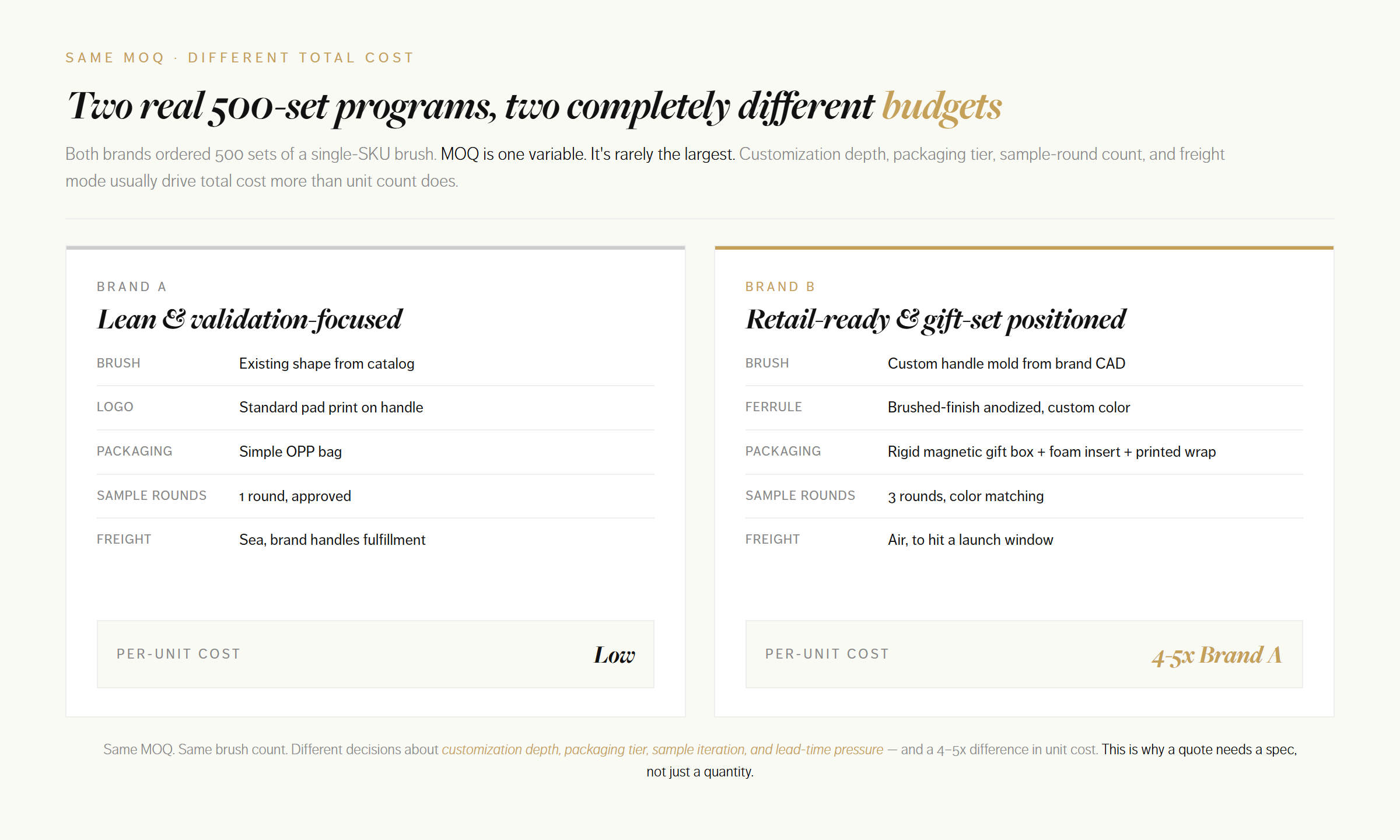
Two real 500-set, single-SKU programs we recently shipped:
Brand A — existing brush shape from catalog, standard pad-print logo, simple OPP bag packaging, sea freight. Low per-unit cost.
Brand B — custom handle mold from brand CAD, brushed-finish anodized ferrule, magnetic gift box + foam insert + printed wrap, three sample rounds, air freight. 4–5x Brand A.
Same MOQ. Same brush count. Completely different cost profile.
MOQ is one variable. It’s rarely the largest. The decisions about customization depth, packaging tier, sample iteration count, and lead-time pressure usually drive total cost more than the unit count does. (For where those unit-count minimums come from in the first place, see makeup brush MOQ explained.)
The cleanest way to see how spec decisions translate into actual launch totals is to walk through two recent project budgets at different tiers.
Per-unit landed cost: ~$9.50 · Total program: ~$4,750
A clean validation launch. The brand committed to $15 retail on DTC, hit ~70% sell-through inside 12 weeks, and used the reorder budget to upgrade packaging on launch two.
Per-unit landed cost: ~$9.45 · Total program: ~$14,180
3x the units of Example A — and about 3x the total — because the per-unit landed cost is almost identical. The brand traded a bit of margin for premium positioning at $28 retail, sold through ~60% inside the holiday window, and earned enough revenue to fund a custom-mold launch in year two.
The pattern across both examples: the differences in spec move the brand’s retail positioning more than they move the per-unit math. A brand willing to invest 3x more capital up-front gets to play in a different retail tier — not in fundamentally different unit economics.
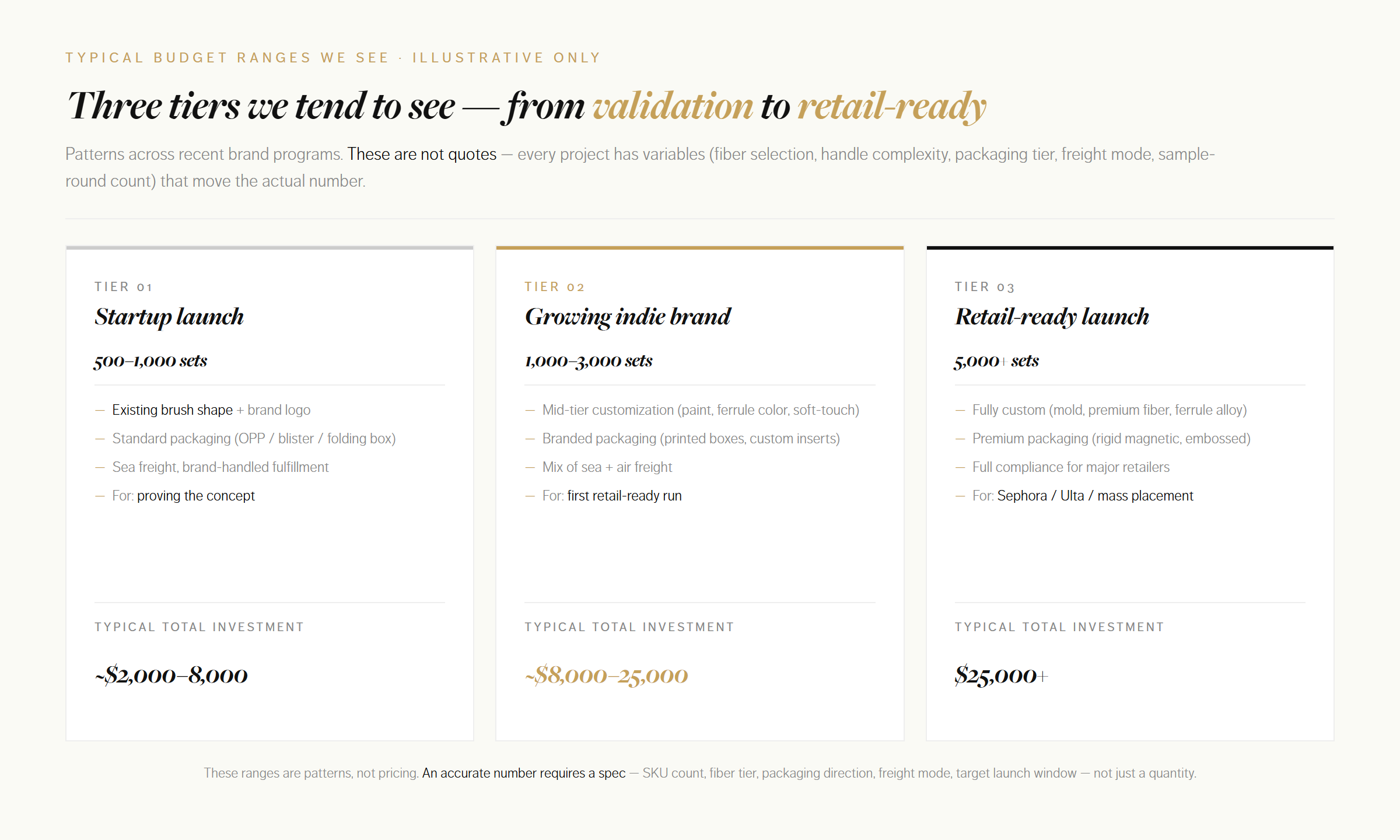
Same unit count, very different budget — a 500-set program of 5-brush kits costs roughly 5x a 500-set program of single-brush SKUs. The ranges below assume single-SKU programs at the lower end of each tier. Multi-brush sets, multiple SKUs, or aggressive customization push toward the top of each tier — or above.
What actually moves the budget within each tier: brush count per set, fiber tier, packaging complexity, freight method, and market compliance requirements.
Most first-time brands start here. Enough volume to validate that a customer actually wants the brush, without committing capital to fully custom tooling.
This is the tier where the brand starts building real shelf presence — and where the packaging budget often catches up with the brush budget for the first time.
This is the tier required for major-retailer placement (Sephora, Ulta, mass).
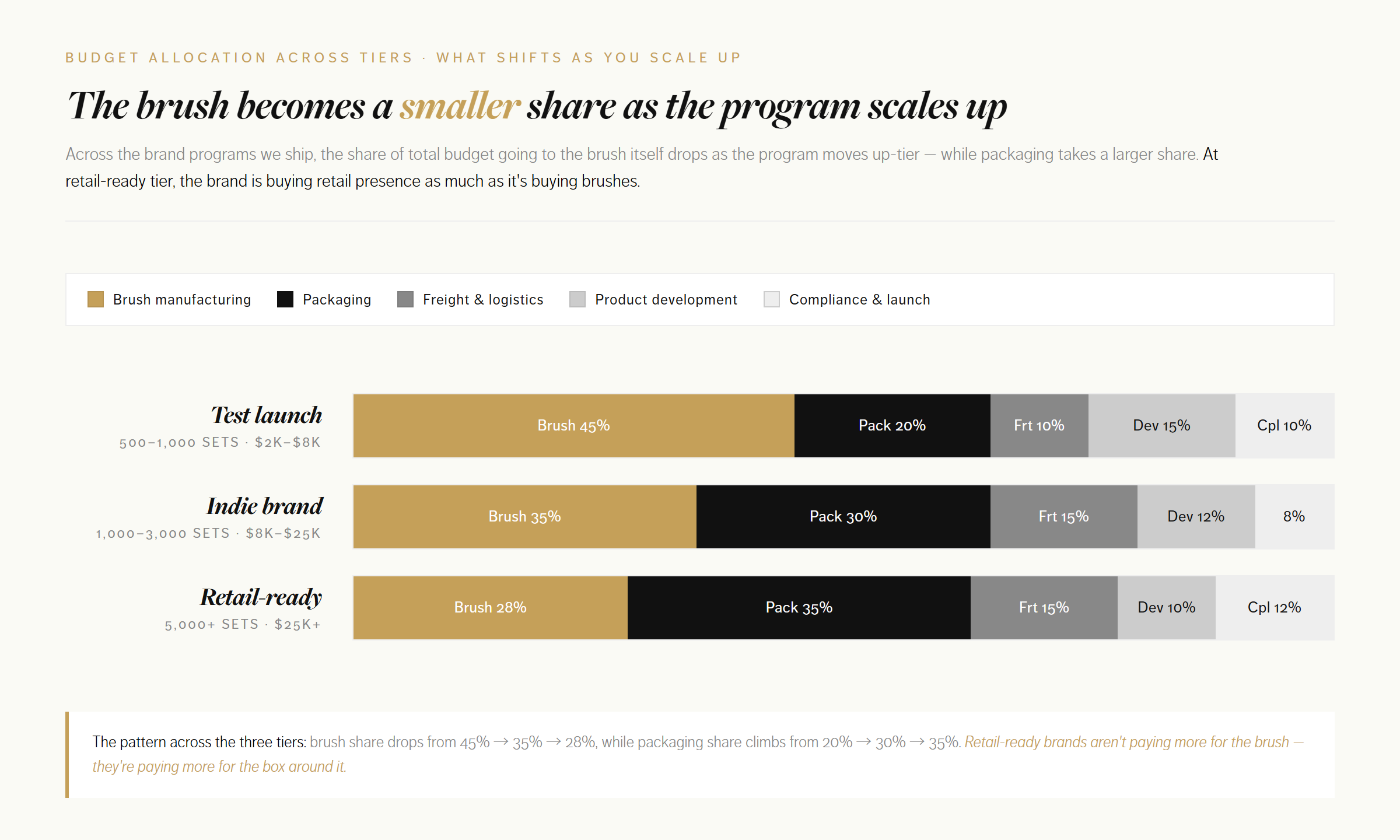
The visual above shows a pattern most first-time brands don’t see coming: as a brush program moves up-tier, the brush itself takes a smaller share of the total budget — and packaging takes a larger one. At test-launch tier, the brush is typically 45% of the total; by retail-ready tier, it’s closer to 28%. The brand is buying retail presence as much as it’s buying brushes.
For a faster mental model than the cost-impact table below, here’s how the four most consequential decisions cluster into three archetypes:
| Decision | Low budget | Mid budget | Premium |
|---|---|---|---|
| Brush shape | Existing catalog mold | Modified existing mold | New custom mold |
| Fiber | Standard cosmetic-grade PBT | Premium modified PBT | Toray-grade |
| Packaging | OPP bag / folding box | Printed branded box | Magnetic gift box |
| Freight | Sea | Mixed sea + air | Air |
A brand that picks the Low column across all four decisions — catalog brush shape, standard PBT, OPP packaging, sea freight — almost always lands in the $3,000–$8,000 range for a 500–1,000 set program. The Mid column typically lands in the $8,000–$20,000 band. The Premium column at 5,000+ units is the $25,000+ tier.
Most brand programs end up mixing columns — a Mid brush spec with Low packaging, or Premium fiber with Mid packaging. The mix is what shapes the final number, and the cost-impact table below shows how each individual decision moves it.
Some budget decisions move the total up a little. Others move it up a lot. Knowing which is which is what lets a brand pull the right lever when a private label makeup brush cost quote comes back higher than expected. (For reading a quote lever by lever, see how much a custom makeup brush costs; for why two similar brushes get different quotes, see why similar brushes cost differently.)
| Decision | Cost impact |
|---|---|
| Upgrade fiber tier (modified PBT → Toray-grade) | Medium |
| Custom handle mold | High |
| Magnetic gift-box packaging | Very High |
| Air freight (vs sea) | Very High |
| Additional sample round | Medium |
| Logo printing (vs no logo) | Low |
| Custom ferrule alloy (vs standard) | Medium–High |
| Custom ferrule color (vs catalog) | Low–Medium |
| Hot-stamp / laser engraving (vs pad print) | Medium |
| Multi-SKU coordination | Medium |
| Soft-touch handle coating | Medium |
| Printed outer wrap (vs plain) | Low–Medium |
The “Very High” tier decisions are the ones that quietly turn a $5,000 launch into a $25,000 one. They aren’t always wrong — magnetic gift-box packaging earns its premium when brand positioning supports it. But they should be deliberate decisions, not default ones.
Most first-time founders start with “500 pieces is too many, can you do 200?” — but the underlying anxiety is rarely about MOQ itself. A brand worried about a 500-piece MOQ is often really worried about tying up $6,000 in inventory before knowing whether the brush will sell.
MOQ is an inventory question. Cash flow is a survival question.
The four decisions that more often become the real problem: late packaging decisions (dieline rework + air freight to recover lost time), mid-program design revisions (each one adds 2–4 weeks and the total often exceeds the MOQ-driven inventory cost), cash flow planning (commitments the second PO can’t fund), and inventory forecasting per variant (allocating MOQ across colors and SKUs in proportion to actual demand). The factories that consistently help brands launch on schedule aren’t the ones offering the lowest MOQ — they’re the ones working through these four decisions with the brand before sampling starts.
Across the over-budget projects we’ve seen, four patterns repeat:
Mistake #1 — Custom mold before product-market fit. Tooling locks the handle design before the brand knows whether the brush will sell. Use an existing shape on launch one; tool a custom mold on launch two once the brush is proven. (We weigh that whole choice in private label or fully custom.)
Mistake #2 — Luxury packaging before customer validation. Building a $4 packaging budget around a $3 brush before the brush is selling locks up capital in a presentation the customer hasn’t yet decided is worth paying premium for.
Mistake #3 — Air freight because development started too late. Air at $3–$5 per set on a 1,000-set program is several thousand dollars that came out of someone’s pocket. It’s almost always the cost of starting development too late.
Mistake #4 — Cheapest brush, most expensive box. Cost-optimizing the part the customer feels (brush) while over-investing in the part the customer photographs (packaging). Reviews drive repurchase. Packaging doesn’t.
In short: spend more on the brush itself — fiber tier, bundle design, sample validation — and less on visible upgrades that don’t drive review scores (custom handle molds, luxury gift boxes, premium surface finishes) until the brush has market signal. Brushes that perform well over months and wash cycles are also the ones that get re-purchased — see our notes on why brushes behave differently after repeated washing and on why some brushes “eat” foundation for the structural reasons brush performance differs at retail. Which of those upgrades to fund first — and which to defer until the brush has proven itself — depends heavily on how you sell; we break that decision down channel by channel in what beauty brands should invest in first: product or packaging. The launches that prove the brush is wanted get to invest in the visible upgrades on launch two.
(We cover first-launch budget allocation, MOQ planning, and sample sequencing for startup brands in more depth in our guide to starting a private label makeup brush line.)
Across the first launches we’ve watched go on to second and third reorders, the financial pattern is remarkably similar:
| Metric | Typical successful first launch |
|---|---|
| MOQ | 500–1,000 sets |
| Retail price | $15–25 |
| Gross margin target | 60–75% |
| Sell-through goal | 60% in first 90 days |
| Reorder trigger | 40% inventory remaining |
What’s not in this table: maximum profit. The most successful first launches aren’t designed to maximize profit. They’re designed to validate demand while preserving cash for the second order — what we describe to brand partners as “a paid market test that pays its own bills.”
| Retail price | Channel fit | Brand positioning | Budget tier most aligned |
|---|---|---|---|
| $8–12 | Amazon, mass retail | Volume / value | Test launch ($2K–8K) |
| $15–25 | DTC, indie e-commerce | Quality story, clean design | Indie brand ($8K–25K) |
| $25–45 | DTC premium, Sephora Collection-tier | Performance + brand world | Retail-ready ($25K+) |
| $45+ | Prestige, professional MUA | Specialty fiber, premium materials | Retail-ready ($50K+) |
A healthy DTC margin model assumes landed unit cost (brush + packaging + freight + duties) at roughly 20–30% of retail. A $15 retail brush absorbs $3–5 in landed cost; a $40 retail brush absorbs $8–12 — which is what supports premium fiber and gift-box packaging without compressing margin. The mismatch shows up when budget tier and retail price don’t fit each other — and both need to be decided together, not separately.
(For programs that have already cleared validation and are now scaling — multi-SKU planning, annual cost cycles, packaging standardization across SKUs — we cover the budgeting framework for established beauty brands in our guide to annual cost planning for an established brush program.)
Meet Cosmetics has supported beauty brands in more than 40 countries through custom brush development, backed by ISO 9001 quality management, BSCI social compliance, FSC-certified packaging options, SGS-tested material lots, and REACH-compliant material sourcing. Across the brand projects we’ve shipped — from first-time indie launches to multi-SKU retail-ready programs — the patterns in this article come from direct floor-side experience, not from secondhand industry reporting. Our work isn’t to push the cheapest line — it’s to keep the budget proportions sensible against what the brand is actually trying to ship.
The specific levers we use most often:
Catalog brush shape library. Our existing molds cover the most-asked shapes (powder, foundation, blush, eye blend, fan, kabuki, contour). A brand using a catalog shape on launch one avoids tooling cost entirely — typically saving $1,500–$5,000 in fixed development cost.
FSC and recycled packaging options. For brands building sustainability into positioning, we maintain FSC-certified box stock and recycled-content packaging options without the surcharge premium typical of niche-sourced sustainable packaging.
Sample optimization process. Each additional sample round adds 2–4 weeks and real cost. We work with brand teams to tighten the brief upfront so first-round samples land closer to approval — often reducing total sample rounds from 3+ to 1–2. (For more on why even an approved sample isn’t a guarantee of bulk consistency, see our piece on sample approval as a milestone, not a guarantee.)
MOQ planning across SKUs. For multi-brush kits, we run MOQ planning per SKU and per color so a brand isn’t forced to over-order one variant to meet a single-spec floor — a common reason kits over-budget.
Freight planning. We run sea-vs-air calculations against the brand’s launch window so freight choice is a deliberate trade-off, not a default. For brands with hard windows, mixed-mode freight (partial air, partial sea) often comes out 30–40% cheaper than full air.
The pattern across these levers: most launch-cost overruns come from decisions made in isolation. We try to surface them as connected decisions before sampling starts.
Across hundreds of custom brush programs, the brands that launch most efficiently are rarely the ones spending the most. They’re usually the ones making the right decisions at the right stage of development.
The most successful brush launches we ship aren’t always the ones with the largest budgets. They’re usually the ones where the budget is allocated to the things customers actually notice — brush performance, fiber feel, consistent quality from unit to unit — rather than to the things the brand notices on a quote sheet.
The most useful budget conversation usually happens before sampling starts. Once a project enters development, changing direction becomes progressively more expensive — and the cost gaps between the most common decisions (custom mold vs catalog shape, premium fiber vs cosmetic-grade, magnetic gift box vs simple folding box, air freight vs sea) become harder to reverse cheaply once tooling, dielines, and material lots are committed.
That’s why we typically begin a brand conversation with retail price, target customer, launch channel, and timeline — before discussing brush specifications. When those four variables are clear, building a realistic budget for a custom makeup brush program becomes much easier, and the brush spec that emerges usually lands close to right on the first sample round, not on the third. The same logic sits behind why we sometimes can’t quote a makeup brush immediately — a quote is only as accurate as the information behind it.
If you’re at the early stage of planning a custom brush line, send us those four variables — retail price, target customer, launch channel, timeline. We’ll work back to a realistic launch budget with you before sampling starts.
Or, lighter entry point — free brush launch budget review. Not sure whether the launch budget you have in mind is realistic for what you’re trying to ship? Send us your target retail price and the MOQ tier you’re considering, and our product team will provide a preliminary budget assessment before any sampling begins — no commitment to move forward required. Not sure how to assemble those details? Our OEM brush brief guide is the simple template for exactly what to send.
Most first-time launches we see sit in the $2,000-$8,000 range for 500-1,000 single-SKU sets with simple customization and standard packaging. A retail-ready launch with custom tooling and premium packaging is more often $25,000+ for 5,000+ units. If you’re looking for a one-sentence answer, most first-time brush brands launch somewhere between $3,000 and $15,000, depending on customization depth, packaging tier, and freight strategy.
The budget ranges discussed in this article focus on manufacturing-related launch costs – sampling, production, packaging, compliance, and freight. Costs such as website development, product photography, paid advertising, influencer partnerships, trademark registration, and customer acquisition are separate business expenses that vary significantly between brands and aren’t included in the factory-side figures here.
Yes. $5,000 sits comfortably in the test-launch tier – typically 500-800 sets, single brush SKU, existing brush shape from the factory catalog with a custom brand logo, simple packaging (OPP bag, blister, or simple folding box), and sea freight. It’s enough to validate that customers actually want the brush before committing capital to custom tooling or premium packaging on launch two.
Start with a single-SKU test launch at 500 sets, using an existing brush shape from the manufacturer’s catalog rather than commissioning a custom mold. Add a simple brand logo via pad print, use entry-level packaging (OPP bag or folding box), and ship by sea. This approach typically lands in the $2,000-$5,000 range for a complete launch, validates market demand, and preserves capital for launch two once the brush is proven to sell.
It varies by tier. Stock brush shapes with brand logo can start at 500 sets. Custom handle molds typically need 1,000-3,000 sets to amortize the tooling cost. Premium fiber tiers (such as specific Toray PBT grades) carry their own MOQ at the fiber level – often 100-200 kg per color, which equates to roughly 25,000-60,000 brushes.
Yes – this is one of the most common starting points we see. 500-1,000 sets is enough to validate that a customer actually wants the brush, without committing capital to fully custom tooling. The trade-off is that some customization options (custom handle molds, custom ferrule alloys) need larger volumes to be commercially viable.
Yes – and most first-time brands do. Over 90% of the launches we see start with an existing brush shape from the factory catalog, combined with custom brand logo, color, and packaging. Custom handle molds typically become commercially sensible at launch two or beyond, once the brush itself is proven to sell. Tooling on launch one locks the design before the brand has market signal.
Often, yes – especially on first launches. A rigid magnetic-closure gift box with foam insert can cost several times what a simple brush inside it costs. On a recent gift-set program we shipped, packaging totaled roughly $4.80 per unit against a $2.50 brush – packaging at 1.9x the brush itself.
Packaging costs span an extremely wide range. A simple OPP bag costs cents per unit. A folding printed box typically runs $0.30-$0.80 per unit. A printed rigid box with inner tray runs $1.20-$2.50. A magnetic-closure gift box with foam insert and printed outer sleeve can land at $3.50-$5.00 per unit. The packaging decision often shifts a brush program by 50% or more in total per-unit cost – which is why packaging is the line most likely to surprise a brand on its first quote.
Custom handle mold tooling typically costs $1,500-$5,000+ per mold as a one-time fee. The exact cost depends on handle complexity (simple cylinder vs sculpted ergonomic shape), material (plastic injection vs aluminum vs wood turning), surface finish requirements, and whether the brand wants a single cavity or a multi-cavity tool for higher-volume production. On first launches, using an existing brush shape from the manufacturer’s catalog avoids this cost entirely – which is why most first-time brands tool a custom mold only on launch two or beyond.
Wholesale (off-the-shelf) brushes are cheaper per unit and faster to launch, but offer almost no brand differentiation – the same brush is available to any competitor. Custom manufacturing carries a meaningfully higher per-unit cost on the first run but produces a brush only your brand sells, with the brand’s logo, color, packaging, and (optionally) handle silhouette. For an Amazon volume-play, wholesale plus brand logo is often the right answer. For a DTC brand building long-term equity, custom manufacturing pays back through differentiation – even at higher per-unit cost.
In most DTC and retail models, makeup brushes are among the higher-margin beauty categories. Three structural reasons: brushes don’t expire (unlike skincare or color cosmetics), they have relatively low return rates compared to formulated products, and they sustain gross margins of 60-80% when positioned correctly against landed unit cost. The catch is that profitability depends on landed cost (brush + packaging + freight + duties) staying within roughly 20-30% of retail price – which is why budget allocation between brush, packaging, and freight matters more than total budget size.
Sometimes. Air freight is worth its premium when it’s protecting a launch window – Black Friday, holiday season, a retail placement date, a paid-media activation calendar. For programs without a hard window, sea freight saves several thousand dollars on a 1,000-set program and adds 4-6 weeks of lead time. The honest test is whether your launch revenue more than covers the air-freight premium.
Depends on volume. Custom molds carry a one-time tooling cost (often $1,500-$5,000+) that amortizes across the run – so the per-unit impact drops as volume grows. Custom packaging is a per-unit cost that scales linearly with volume – which means at larger order sizes, packaging often outpaces tooling as the larger total line item.
From kickoff to delivered inventory: typically 10-16 weeks for a simple custom line, 16-24 weeks for one with custom tooling and premium packaging. (We break the production portion down day by day in makeup brush lead time.) The single biggest variable is sample-round count – each additional round adds 2-4 weeks. Brands that arrive with clear creative briefs and respond to sample feedback quickly tend to launch in the shorter end of the range.
For brands building long-term equity, almost always yes. Custom brushes carry meaningfully higher gross margins than resold wholesale (typically 60-80% vs 30-50%) and create real differentiation – the same brush isn’t available to every competitor. For one-off Amazon volume plays with no brand vision beyond 12 months, wholesale plus brand logo can be the right answer. The custom premium pays back through differentiation, review scores, and brand-defensibility over multiple reorders.
Healthy DTC brush programs typically run 60-75% gross margins. Brushes are among the highest-margin beauty categories – they don’t expire, return rates are low compared to formulated products, and landed cost (brush + packaging + freight + duties) can be kept at roughly 20-30% of retail when budget allocation is sensible. Margin compresses when the brand over-invests in packaging relative to brush spec, or when freight wasn’t planned against the launch window.
For a first launch, most successful brands size the initial PO to land roughly 6-12 weeks of forecasted demand at a conservative sell-through assumption (60% in 90 days). Carrying more ties up cash before you have demand signal; carrying less risks stockouts during the very window when paid media and PR are most expensive to restart. The reorder PO should typically be triggered when inventory hits about 40% remaining, leaving 6-8 weeks of lead time to ship the next run.
