


A factory-level explanation of fiber density, pickup, release, and brush engineering.
Why does one foundation brush leave a seamless finish while another leaves streaks — even when both are sold as “premium synthetic”?
Why do some brushes feel cloud-soft on the back of the wrist but stiff after the third wash?
Why do two brushes that look identical online behave completely differently once they touch product?
In most cases, the answer is not the brush shape, the brand, or the fiber name on the label. It is density.
Brands talk about brush softness. Factories talk about packing ratio. Both sides are describing the same thing from opposite ends — and the gap between those two languages is where most brush development conversations go wrong.
Most beauty brands spec their brushes by talking about feel. “Soft.” “Plush.” “Buttery.” These words describe a perception. They do not describe an engineering parameter, and they do not survive translation to a production line in any reliable way.
The parameter that actually drives the perception — and the makeup brush performance customers experience over hundreds of uses — is fiber density. Density is the ratio of bristle volume to empty space inside the bundle. It determines how much product the brush picks up, how it releases that product onto skin, how the bristles spring back under pressure, and how the brush ages across washes. It is the single most under-discussed variable in brush development conversations, and the one most often miscommunicated between brand and factory.
This article is for product and R&D leads who want to spec brushes in language an OEM makeup brush factory can actually build to. We will walk through what fiber density is, how dense versus loose brushes behave differently, why pickup and release pull against each other, why liquid products require a different density logic than powders, and how to map density choices to a coherent product line.
The patterns we see most often in beauty-brand customer reviews and support tickets:
All five are usually density-and-release problems, not brush-category problems. A brush labeled “foundation brush” can read any of these ways depending on the density tier, fiber chemistry, and tip geometry the factory built it to. The rest of this article walks through why — and how brands can spec the brush so the customer reviews read differently.
Fiber density is a packing ratio. Take a fixed bundle diameter at the ferrule — say a powder brush at 25mm — and count how many individual bristles are packed into that cross-section. A high-density brush at that diameter might hold a tightly packed bundle weighing significantly more than a low-density brush of the same outer dimension. The brushes look similar in profile photos. They behave like different tools in the hand.
Density depends on three production decisions:
Fiber diameter. Finer fibers (in the sub-0.1mm range, typical of premium synthetic Taklon and ultra-fine PBT) pack more bristles into the same bundle volume than coarser fibers. Density and softness usually correlate at this level — finer fiber feels softer, and finer fiber also packs denser.
Bundle weight per ferrule diameter. The factory specifies how many grams of fiber are crimped into each ferrule. Hold the diameter constant and increase bundle weight, and density rises. This is the most direct production lever.
Crimp pressure and ferrule geometry. A tighter ferrule crimp packs the same bundle weight more densely. A wider ferrule mouth with the same bundle weight reads looser. Two factories given the same bundle weight spec can produce visibly different densities if their crimping equipment is calibrated differently.
For a brand reading this: when you ask a custom makeup brush manufacturer to “make it denser,” you are usually asking for one of those three changes. Naming which one upfront cuts a round of sampling.
Factory Note
The brush “feel” customers describe at first touch is rarely about density alone. It is the combination of density, fiber diameter, and tip geometry — tapered, cut, or domed. Most brands ask for “denser” when they actually want “medium density with a tapered tip on a finer fiber.” Same perceived softness, completely different production spec.
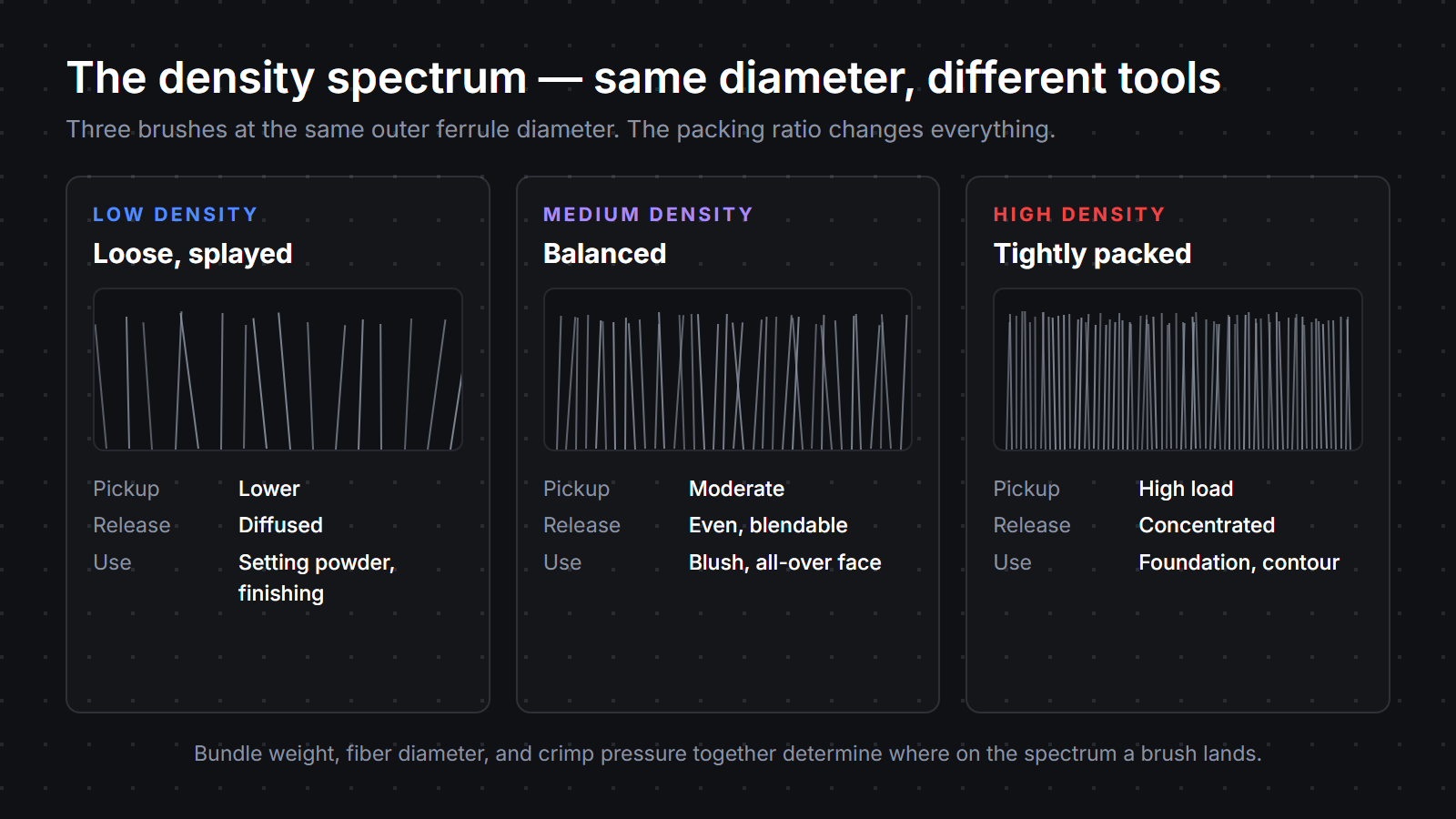
The behavior gap between a dense bundle and a loose bundle of the same outer dimension is wider than most brand teams expect on the moodboard.
A dense brush holds more product, deposits color more concentratedly, and resists splaying under pressure. The tradeoff is that it can over-deposit on lightly pigmented formulas, drag slightly on dry skin, and feel “firm” even when the underlying fiber is soft. Use cases where density wins: buffing foundation, contouring, packing pigmented shadow, applying densely pigmented blush.
A loose brush picks up less product per dip, deposits in a diffused pattern, and gives a softer, more airbrushed finish. The tradeoff is less control on precise placement and weaker pigment payoff with low-load formulas. Use cases where lower density wins: setting powder, finishing veil, sheer wash blush, blending edges.
The decision is not “denser is better.” It is “match density to the deposit profile your product needs.”
| Density tier | Typical use cases | Pickup behavior | Release behavior |
|---|---|---|---|
| High density (tightly packed) | Foundation buffing, contour, dense pigment shadow | High load per dip | Concentrated, controlled deposit |
| Medium density (balanced) | Blush, all-over face, blending shadow | Moderate load | Even, blendable deposit |
| Low density (loose, splayed) | Setting powder, highlight veil, finishing | Lower load per dip | Diffused, airbrushed deposit |
The same brush category — say “powder brush” — exists across all three tiers. Knowing which tier your product needs is more useful than knowing the category name.

The two functions a brush has to balance are pickup (how much product loads into the bundle from the pan) and release (how much of that product transfers onto skin). They are not independent variables. They pull against each other.
A bundle that grabs product aggressively also tends to hold onto it, which means more taps to release, more streaking risk, and more product wasted in the bundle. A bundle that releases easily often did not load very much product in the first place, which reads to the customer as a “weak” brush. The engineering goal is to find the geometry that loads efficiently AND releases evenly — and that goal is closer to medium density than to either extreme.
Three levers move the pickup/release curve:
Tip geometry. Tapered tips load less but release very evenly. Cut tips load more but release less smoothly. Domed tips sit between the two. Most modern face brushes use tapered tips with medium-to-high density precisely because that combination balances both functions.
Fiber tip shape (per-fiber). Synthetic fibers are extruded with shaped cross-sections — round, star, hollow-core — meaning each individual bristle, sliced across its width, can be a circle, a star, or a hollow tube depending on the extrusion die. The working tip of that fiber can then be cut flat or tapered to a point in a separate finishing process. Tapered fiber tips behave differently from cut fiber tips even at identical density. This is the lever brands almost never spec, and it is the lever that often explains why two factories produce visibly different “feel” from the same bundle weight.
Fiber memory. A bundle springs back to shape after each pass. Higher memory (typical of higher-grade PBT) gives a brush more consistent pickup across hundreds of uses. Lower memory bundles flatten over time, and their pickup drops. Spec the fiber, not just the density, if the brand promise includes longevity.
Factory Note
A bundle with tapered fiber tips behaves like a lower-density brush on release while still loading like a medium-density brush on pickup. This is why we steer most modern face-brush programs to tapered-tip synthetics — they unlock the pickup/release combination that brand briefs almost always describe but rarely spec.
Density logic for powders breaks down on liquids. Liquid foundation, cream blush, gel highlighter, and tinted skincare all interact with fiber differently from dry pigment, and the density that works for powder will streak or pool for a liquid.
The first principle is fiber chemistry — and this is where the synthetic vs natural makeup brush question stops being aesthetic and starts being functional. Natural hair (goat, squirrel, pony) is biological and absorbs liquid into the cuticle structure. This is why natural hair is rarely preferred for modern liquid foundation applications — the product wicks into the bundle and does not release cleanly onto skin. Synthetic fibers (Taklon, PBT, polyester blends) are non-absorbent and sit on top of the liquid, which is the behavior most cream and liquid formulas actually need. There are still niche applications where natural-hair blends work on cream products, but the modern default for liquid foundation is synthetic.
The second principle is bundle density. For liquid products, you want medium density — enough fibers to spread the liquid evenly without streaking, but not so densely packed that capillary action holds the product inside the bundle. (Capillary action is what makes a tightly packed sponge hold water: the foundation gets trapped between the bristles instead of transferring cleanly onto skin.) Too dense + liquid means product sits in the brush, not on the skin. Too loose + liquid means uneven blending and visible streaking.
The third principle is tip taper. Tapered tips on fine synthetic fibers are the standard for liquid foundation brushes because they distribute product through a smaller surface area at the working edge, which is where blending happens. Cut-tip dense bundles work for cream blush only when the bundle is “duo-fiber” — a mix of fiber lengths or types that creates more spacing inside the bundle and reduces saturation buildup, so product is not held inside the bristles under capillary pressure.
For brand R&D teams formulating a brush alongside a new product launch, the question is not “what density.” It is “what density, what fiber chemistry, what tip taper, and what fiber memory” — all four together. Get one of them wrong and the brush will feel inconsistent with the product even if the other three are right.
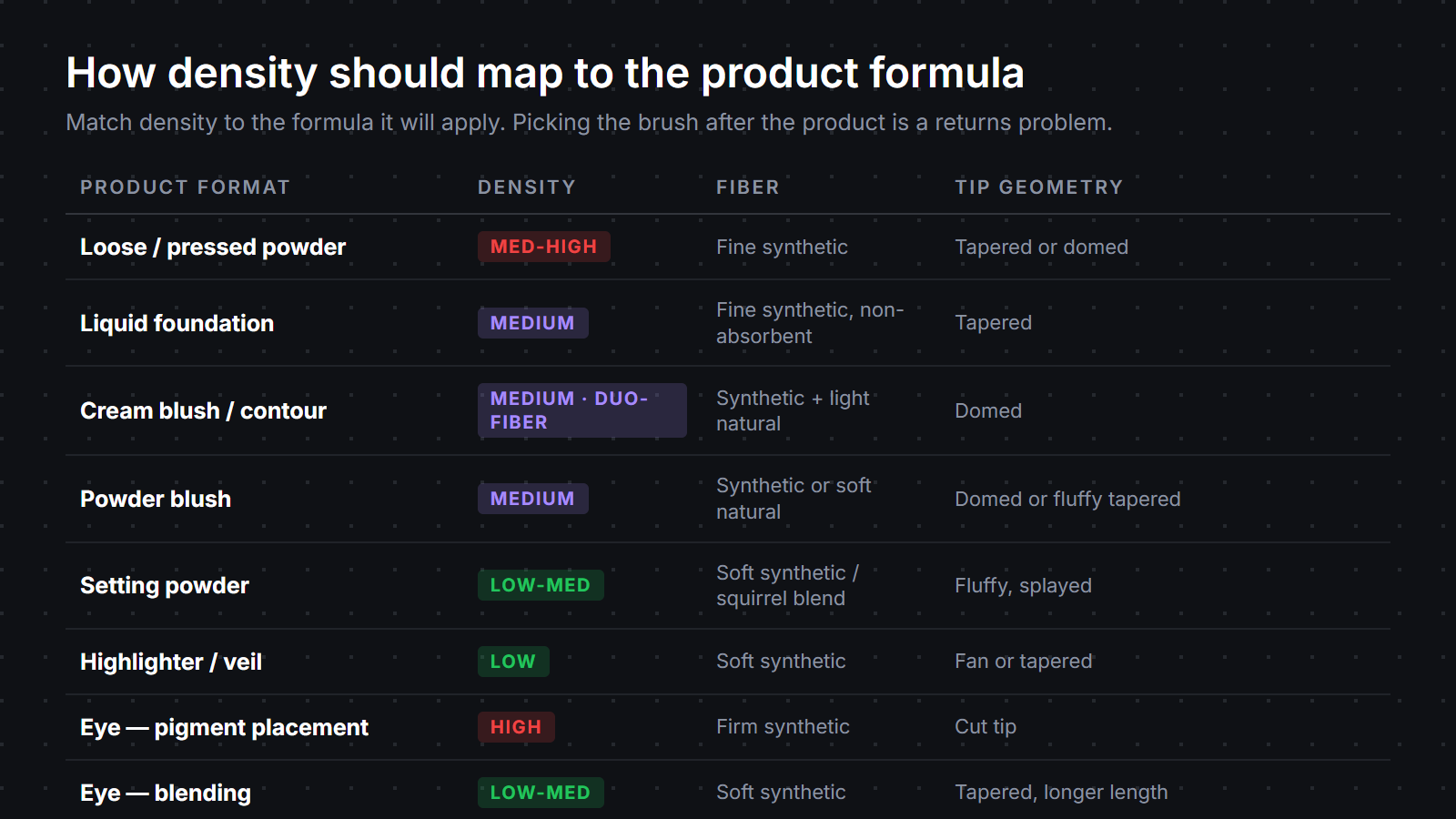
A brush line developed in isolation from the formulas it will apply is a brush line that will get returns. Density should be specified product-by-product, in tandem with the formulation team.
| Product format | Recommended density tier | Recommended fiber | Tip geometry |
|---|---|---|---|
| Loose / pressed powder foundation | Medium-high | Fine synthetic (sub-0.1mm) | Tapered or domed |
| Liquid foundation | Medium | Fine synthetic, non-absorbent | Tapered |
| Cream blush / cream contour | Medium, often duo-fiber | Synthetic + low-load natural blend | Domed |
| Powder blush | Medium | Synthetic or soft natural | Domed or fluffy tapered |
| Setting powder | Low-medium | Soft synthetic or squirrel-blend | Fluffy, splayed |
| Highlighter / finishing veil | Low | Soft synthetic | Fan or tapered |
| Eye shadow (pigment laydown) | High, small diameter | Firm synthetic | Cut tip |
| Eye shadow (blending) | Low-medium | Soft synthetic | Tapered, longer length |
The pattern across this table: dense-and-firm for placement, loose-and-soft for diffusion. Brands building a cohesive line usually have at least one of each in their hero set, and the density logic guides which formula goes with which brush — not the other way around.
For a deeper walkthrough on how these decisions interact with MOQ and customization, our guide to scoping a private label brush line covers the brush-by-formula mapping that successful indie brands use during kickoff. Color and ferrule specifications get separate treatment in our piece on anodized ferrule color matching — both decisions usually need to be made in parallel.
The same density mistakes show up across new brush programs almost every quarter.
Asking for “dense” when the product needs medium. This is the most common one. Brand teams interpret “premium” as “dense” and ask for the densest possible bundle. The result on a soft-pigment formula is a brush that over-deposits and drags. Density is a tool, not a quality grade.
Treating density as a single number. Density without fiber diameter and tip taper is incomplete information. A high-density bundle on a coarse fiber feels stiff and abrasive. A high-density bundle on fine fiber with tapered tips feels soft and precise. Same bundle weight, completely different brush.
Forgetting fiber memory on the longevity promise. A bundle that performs beautifully on day one but flattens by month six has a memory problem, not a density problem. Brands selling a “premium” brush at premium price points need to spec fiber memory explicitly, not assume it.
Specifying density without specifying the product it pairs with. A brush line designed without reference to the formulas it will apply is a guessing game. The factory can build to any density spec you provide. We cannot guess whether that spec matches the cream blush the brand is launching alongside it.
Asking for natural hair on a liquid formula. Goat and squirrel fibers absorb liquid into the cuticle. A natural-hair brush on liquid foundation will hold the product inside the bundle and apply it patchy. This is a chemistry issue, not a craftsmanship issue, and no amount of factory care fixes it.
Factory Note
Density is the single most adjustable parameter we control during the bundling step. It is also the parameter most brands under-specify. Walking into a kickoff with a target density tier mapped to each SKU — instead of a single “we want it soft” instruction — usually cuts a full sampling round.
Across the brush programs we ship across powder, cream, and liquid formats, the brands building the strongest lines treat density as a formulation conversation, not a brush conversation. Their product teams talk to their brush teams during the formula development cycle, not after. Density gets specified alongside pigment load, viscosity, and finish target — because all four are part of the same application experience.
The brands struggling are usually the ones who picked the brush after the product was already in market. Density mismatches between brush and formula are obvious to a customer the first time they swatch the product, and customer feedback usually reveals it quickly — long before the next reorder cycle. The brush did not fail. The pairing did.
Many brands mistake “dense” for “premium.” Consumers usually experience the opposite: a brush that drags on skin, over-deposits color, and becomes harder to blend with over time. The density that reads “luxury” in a moodboard often reads “stiff” on someone’s face six months in.
Density itself is not a quality signal. A dense brush is not a better brush — it is a different tool. The brand that understands which tool its product actually needs has already made the decision that separates a cohesive line from a catalog of mismatched components.
Most custom brush development we run starts with the formula, not the handle design. During the sampling conversation, we help brand teams map four parameters together against the actual product texture and finish target:
The goal is to engineer the brush around how the formula behaves on skin — not around a catalog photo. The brands shipping the cleanest first launches are usually the ones who run this conversation before sample round one, not after the first round of customer reviews.
Related: fiber and density are one channel of a bigger picture — see where a brush’s premium feel actually comes from, across touch, hand, eye, weight, and the considered details.
Fiber density is the packing ratio of bristle volume to empty space inside the bundle. It is set by three production decisions: fiber diameter, bundle weight per ferrule diameter, and crimp pressure. Density determines how much product the brush picks up, how it releases onto skin, and how it ages across washes.
No. Density is a tool, not a quality grade. Dense brushes hold more product and deposit concentratedly — good for foundation buffing and contouring, poor for setting powder or finishing veil. The right density depends on the deposit profile your product needs, not on a general ‘denser is better’ assumption.
Natural hair (goat, squirrel, pony) is biological and absorbs liquid into the cuticle, so the product wicks into the bundle and never fully releases onto skin. Synthetic fibers (Taklon, PBT, polyester blends) are non-absorbent and sit on top of the liquid, which is the behavior cream and liquid formulas actually need.
Medium density with fine synthetic fiber and a tapered tip. High density holds liquid inside the bundle and applies streaky. Low density blends unevenly. The medium-density + tapered-tip + non-absorbent-fiber combination is the standard for modern liquid foundation brushes.
Specify density alongside fiber diameter, tip geometry (tapered, cut, or domed), and fiber memory — not as a single number. Saying ‘we want a denser brush’ is incomplete. Saying ‘medium density, sub-0.1mm tapered-tip Taklon, with high fiber memory’ is a spec a factory can build to in one sampling round.
Dense brushes load high product per dip and deposit color concentratedly — better for pigmented blush, contour, and shadow. Loose brushes load less and deposit in a diffused pattern — better for setting powder, highlight veil, and edge blending. The same brush category exists across both density tiers; the right tier depends on the formula.
