


Every week we receive the same email: “Why is your MOQ so high? Another supplier said they can do 100 pieces.”
We understand the question. For a brand spending its own money on a first launch, makeup brush MOQ feels like a wall — a number set arbitrarily by the factory to keep small buyers out. It is not. MOQ is the threshold below which the factory loses money on your order.
First-time founders often interpret a high MOQ as rejection. Factories interpret a low-volume, fully custom project as operational risk. Both sides are reading the same number through different lenses, and the conversation only gets useful when both sides understand the other view.
This article explains where that threshold comes from, why it changes by what you customize, and how indie brands actually get MOQ down without sacrificing the things that matter. If you are scoping your first OEM brush program — or your second, or your third — this is the part of the conversation worth understanding before you ask for a quote.

Production lines have setup costs. Materials have supplier minimums. Operators take time to switch between programs. None of that disappears when an order is small — it just stops being economical.
A simple way to picture it. A factory might spend two days setting up a brush line — tooling adjustment, bristle blend preparation, ferrule batch loading, color trial, QC calibration. Once the line is running, each unit takes a few minutes. Two days of setup plus two days of run time for two hundred units means most of the cost is the setup, and the per-unit price has to absorb it. Two days of setup plus a week of run time for five thousand units spreads that setup across many more units and brings per-unit cost down to something both sides can live with.
That is the entire logic behind cosmetic OEM MOQ. It is not a wall. It is the line at which the factory breaks even on your order, and it is the line below which most serious cosmetic brush suppliers will politely decline.
There is also a second factor most first-time brands underestimate: material lots. Bristle suppliers do not sell fifty grams of synthetic Taklon. Aluminum tube suppliers do not run a hundred ferrules through their extruder. Carton printers do not print fifty branded boxes. Each supplier in the chain has its own minimum, and the factory’s MOQ has to clear the highest of them. If your bristle supplier’s minimum is enough for three thousand brushes, that is your floor, no matter how flexible the factory tries to be.
Factory Note
When a supplier promises you “no MOQ” or “MOQ 100 pieces” on a custom brush, they are usually one of three things: a dropshipper repackaging stock from someone else, a trading company that buys from a factory like ours at our MOQ and resells smaller, or a workshop without the QC discipline that lets them ignore the math. None of those are the same as an OEM makeup brush factory.
A custom brush is built from four material categories. Each one has its own minimum, and your overall MOQ is set by whichever one is highest.
| Material category | What drives the minimum | Typical MOQ impact |
|---|---|---|
| Bristle (synthetic or natural) | Supplier batch minimum for the blend; dyeing cost per run | Adds 1,000–3,000 units floor for custom blends |
| Ferrule (aluminum / copper / plastic) | Extrusion batch size; anodizing bath minimum | Adds 1,000–5,000 units for custom color or shape |
| Handle (wood / plastic) | Wood blank pallet size; injection mold tooling | Adds 500–2,000 for stock handles; 5,000+ for new mold |
| Packaging (cartons, sleeves, inserts) | Printed carton minimums; FSC paperwork lead time | Adds 500–2,000 units depending on print complexity |
Stock components fall at the low end of each range. Custom components — a new bristle blend, a custom anodizing color, a new handle mold — push every column to the right.
This is why two brands can ask us for “a custom makeup brush” and get two completely different MOQs. A brand that wants logo print on a stock handle and ferrule sits near the lower end. A brand that wants a custom bristle blend, anodized in a custom Pantone, on a new injection mold, with printed FSC packaging stacks the maximum of every category. The first brand might launch comfortably at 1,000 units. The second is looking at 5,000 or more — not because we want it that way, but because the math says so. The same custom choices that push MOQ up also stretch the production calendar – we break the timeline down in makeup brush lead time.
A brush is not made by one factory. It is assembled at one factory from components moving through a much longer supply chain, and MOQ pressure is being applied at every node before it ever reaches the brush assembly line.
The actual flow looks like this:
Bristle supplier → Aluminum tube / ferrule supplier → Anodizing facility → Handle mold / factory → Packaging printer → Brush assembly line → QC and logistics
Each link in that chain has its own batch minimum, its own setup cost, and its own lead time. The bristle supplier will not run a dye batch below a commercially viable minimum weight — usually measured in tens of kilograms, with the exact threshold varying by fiber type. The aluminum tube and ferrule supplier schedules production in shifts measured in thousands of units, with separate minimums for cutting, stamping, and rolling steps. The anodizing facility holds bath chemistry stable across a minimum run size to keep color variation within acceptable tolerance. The packaging printer has plate setup fees that only amortize across a few thousand printed cartons.
By the time the components arrive at our brush assembly line, the MOQ floor has already been set upstream — by whichever node in the chain had the highest batch minimum. Our role at the assembly line is to combine those components efficiently, not to magic them into smaller batches than the suppliers will produce.
This is why the most useful question a brand can ask is not “can you lower your MOQ” but “which suppliers in the chain are setting the floor, and which of them can we work around with stock components.” The first question gets a polite refusal. The second gets a concrete answer.
Across the indie OEM launches we ship, programs using stock ferrules, stocked anodizing colors, and existing handle tooling commonly land meaningfully lower in MOQ than fully custom equivalents — because four of the seven nodes in the supply chain have already done their batch run for someone else, and the brand only pays for the marginal customization.

The single biggest lever on your MOQ is how much you actually customize. Most indie brands assume “custom” is one decision. It is closer to four decisions stacked on top of each other.
Layer 1 — what you put on a stock brush. This is the lowest MOQ tier. Take a brush from the factory’s existing catalog, add your logo print, and call it your own. We can usually run programs at this tier from 500–1,000 units per SKU, sometimes lower for established repeat clients.
Layer 2 — customize finish, keep components stock. Same brush, but with your custom handle paint color and packaging. This pushes MOQ into the 1,000–2,000 range because the paint batch and packaging print have their own minimums.
Layer 3 — customize one component, keep the rest stock. A new ferrule color (custom anodizing), or a new bristle blend, or a custom handle shape using existing molds. MOQ usually lands at 2,000–5,000 because at least one supplier batch minimum kicks in.
Layer 4 — fully custom OEM. New handle mold, custom bristle blend, custom anodized ferrule, custom packaging. MOQ rarely starts below 5,000 units per SKU, and the one-time mold or tooling fee adds another fixed cost on top.
For a brand reading this and feeling priced out of Layer 4 — that is the right reaction. Layer 4 is for brands placing repeat orders against a proven sell-through, not for a first launch. Most successful indie brushes launch at Layer 1 or 2, sell through, then graduate into Layer 3 once they have real demand data. We walk through this trade-off in detail in our private label launch guide — it is the single most useful framework we share with first-time founders.
MOQ is rarely interesting on its own. What brands actually care about — and rightly so — is what the MOQ does to per-unit cost. The economics behave predictably across volume tiers, and the curve is steeper than most first-time founders expect.
| Order volume per SKU | Per-unit cost behavior | What’s driving it |
|---|---|---|
| 300–500 units | Highest tier; uneconomic for most factories | Setup cost dominates; supplier minimums under-utilized |
| 800–1,200 units | High but workable for stock-component programs | Setup amortized; bristle and packaging batches partially used |
| 2,000–3,000 units | Economical zone for most indie launches | Full supplier batches used; production line runs efficiently |
| 5,000+ units | Optimized; the curve flattens | Tooling fees amortized; full economies of scale |
The bigger insight is the shape of the curve. The cost gap between 500 units and 1,000 units is usually larger than the gap between 2,000 and 5,000. The early volume increases buy a lot more per-unit savings than the later ones. This is why a launch sized at 1,500 units per SKU often makes more financial sense than the same brand splitting the budget across multiple SKUs at 500 each — the math punishes the lower-volume position twice (once on setup, once on supplier minimums).
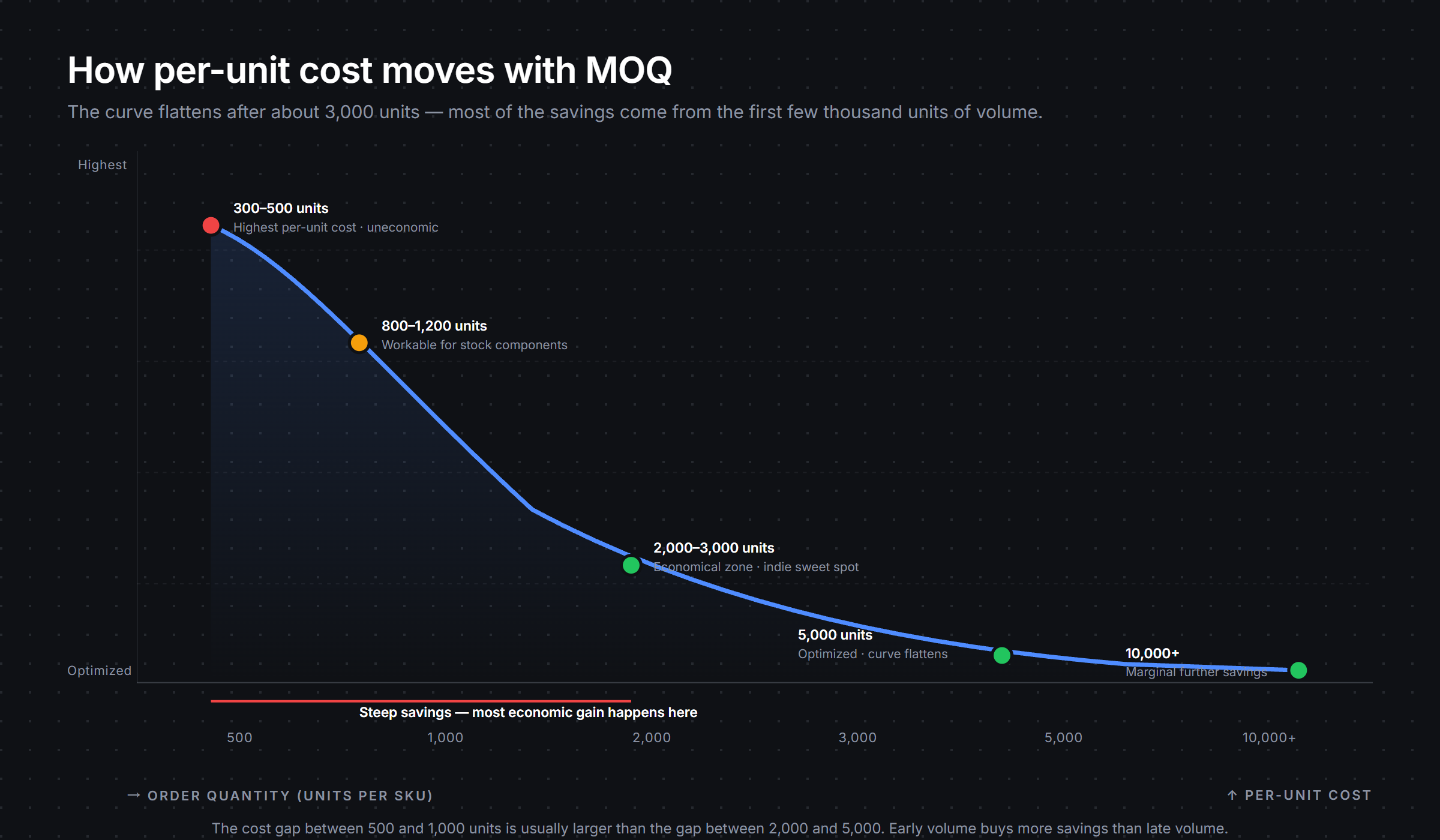
The practical takeaway: do not optimize for the lowest MOQ a supplier will quote. Optimize for the volume tier that brings your per-unit cost into your retail margin band. Below that volume, the unit economics break before the brush even hits a shelf.
Different brand stages need different MOQ strategies. A startup running its first $8,000 launch should not be optimizing for the same MOQ as a Sephora-bound brand sizing its third reorder. The table below maps brand stage to the customization layer and MOQ strategy we usually recommend, based on what works for the indie and growth brands shipping on our floor.
| Brand stage | Typical budget | Recommended layer | MOQ strategy |
|---|---|---|---|
| Pre-launch startup (under $10k) | $3k–$10k | Layer 1 — stock brush + logo | 500–1,000 per SKU; 1–2 hero SKUs only; small batch makeup brush runs are common at this stage |
| Influencer / DTC launch | $10k–$30k | Layer 2 — custom finish + packaging | 1,000–2,000 per SKU; 3 SKU collection |
| Retail-entering brand (Sephora-bound) | $30k–$100k | Layer 3 — one custom component | 2,000–5,000 per SKU; 3–5 SKU launch |
| Established cosmetic brand | $100k+ | Layer 4 — fully custom OEM | 5,000+ per SKU; full collection scope |
Two observations that hold across all four stages. First, the brands moving cleanly to the next tier are almost never the ones who reached upward too early — Layer 4 ambitions on a Layer 1 budget is the most common reason a first launch stalls. Second, the brands that graduate fastest are usually the ones whose first launch sold through quickly enough to fund a second order at one tier up — which is far easier to engineer at Layer 1 with low MOQ and tight unit economics than at Layer 4 with capital tied up in tooling.
If you do not yet know which stage you are in, you are almost certainly at the lower one. That is not a problem — it is just the math.
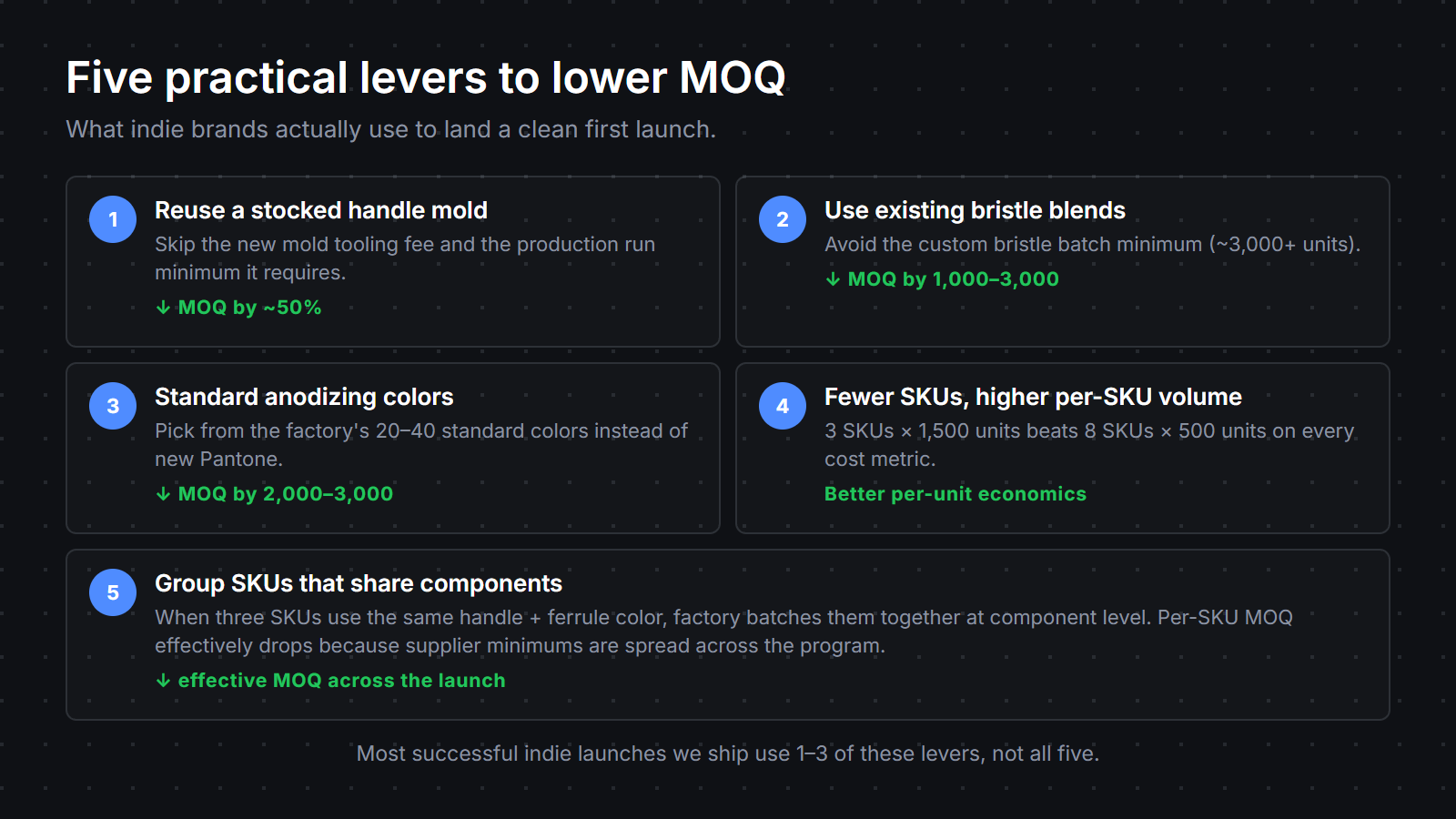
There are five practical levers indie brands actually use to get MOQ down. None of them require begging.
1. Reuse an existing handle mold. A new injection mold for a custom handle is one of the most expensive MOQ drivers — both the tooling fee and the minimum production run to make the tooling worthwhile. Pick a handle from the factory’s library and customize the finish instead. MOQ often drops substantially on programs using existing tooling.
2. Use the factory’s existing bristle blends. Custom bristle blends have batch minimums that almost always force MOQ above 3,000 units. A factory with a deep component library will have a dozen bristle blends already developed — soft synthetics, blended naturals, ultra-fine PBT. Pick the closest existing blend instead of asking for a new one.
3. Standardize on existing anodizing colors. A new Pantone-matched anodized aluminum ferrule color requires its own bath run, with its own minimum. Choose from the factory’s standard color chart — usually 20–40 colors covering most brand palettes — and the color category stops driving your MOQ.
4. Launch with fewer SKUs at higher per-SKU volume. Splitting a budget across eight SKUs at 500 units each is the worst MOQ position you can put yourself in. Each SKU pays its own setup cost, each SKU has its own component minimums, and most likely no SKU gets to a healthy production volume. The pattern that works for indie launches is three to four SKUs at 1,500–2,000 units each — same total order value, much better per-unit economics.
5. Group MOQ across SKUs that share components. If three of your SKUs use the same handle shape and the same ferrule color, the factory can batch them together at the component level. The total order spreads the bristle and ferrule minimums across all three SKUs, lowering the effective per-SKU MOQ. This works best when you commit early to component reuse rather than designing each SKU in isolation.
Factory Note
Most indie brands we work with launch successfully with one or two of these levers — typically reusing a stocked handle and one of our existing bristle blends, while customizing handle color and logo. A program like that lands cleanly at 800–1,200 units per SKU. The brands that insist on Layer-4 customization on their first launch are usually the same brands who do not place a second PO.
A counterintuitive observation worth opening this section with. The brands most damaged by MOQ pressure are usually not the smallest brands. They are mid-sized brands scaling too many SKUs too early — brands with enough budget to feel they should diversify the range, but not enough volume per SKU to clear the supplier minimums on any single product. Pre-launch startups know they have to focus. It is the brand at $50k–$200k of first-launch budget that most often spreads itself thin.
We see the same MOQ mistakes from first-time brands almost every quarter.
Believing “no MOQ” claims. A factory that genuinely offers no MOQ on a custom brush is one of the three things in our earlier Factory Note — and none of them are the partner you want for a brand you plan to scale.
Splitting a budget too thin across SKUs. A 6,000-unit budget across 12 SKUs is 500 units per SKU — a position where every supplier minimum stacks against you and per-unit price stays high. The same 6,000 units across three SKUs is a different conversation entirely.
We watched this play out recently. One startup brand split its first launch across eleven SKUs at 300 units each. The result was higher unit cost than three competing brands at the same scale, packaging printer delays because no single SKU cleared the minimum, and inconsistent component availability across the line. The second launch, after we walked them through this math, reduced the range to three hero SKUs at 2,000 units each. Production became significantly more stable, per-unit cost dropped materially, and the brand had a sell-through story to take to its first retailer meeting. Same total order value. Different commercial outcome.
Locking a custom mold before testing demand. A new handle mold is one of the most expensive decisions a brand can make on a first launch. Use stock tooling for the first run. If the brush sells through, the mold investment is justified for the second order. If it does not, you have not lost the tooling fee on a product that did not move.
Asking for low MOQ, low price, and custom design on the same call. Any two of those three are reasonable. All three together is not a real ask. Serious cosmetic brush suppliers will tell you so politely; less serious ones will quote it anyway and surprise you on quality.
Assuming all factories quote MOQ the same way. Some factories quote MOQ at the SKU level. Some quote it at the program level (total across all SKUs in your launch). Some quote it including packaging, some quote it brush-only. Ask what the number includes before comparing quotes from two suppliers.
The indie brands shipping a clean first launch are almost never the brands with the lowest MOQ. They are the brands who matched their MOQ to a realistic sell-through forecast.
A brand confident it can sell 2,000 units of a hero SKU in six months should not be optimizing for a 500-unit MOQ. Their problem is not the MOQ; it is making sure those 2,000 units land at a per-unit cost that supports their retail margin. (How to estimate what your market can actually absorb — the demand side of this equation — is its own question: how many makeup brushes does your market really need.) A brand unsure whether it can sell 500 units should not be ordering 2,000.
This is the conversation worth having before you ask a factory for a quote. Not “what is your minimum?” but “what does a 1,500-unit run actually cost me, and what does it look like one tier up and one tier down?” That conversation gets you a real answer, and it tells you whether the supplier on the other end thinks like a partner or like a transactional vendor.
For brands earlier in the design phase, our walkthrough on scoping a private label makeup brush line from kickoff to launch covers how each customization layer interacts with MOQ in more detail, including the brush-type and SKU-scope decisions that ultimately drive cost.
The real risk in cosmetic OEM is usually not high MOQ. It is low-volume fragmentation — too many SKUs at not enough volume per SKU, with every supplier minimum stacked against the program at once. A brand that understands its own unit economics rarely struggles with MOQ. A brand that does not understand its unit economics struggles regardless of which MOQ the factory quotes.
The makeup brush MOQ question is the most common one we receive, and it is almost always the wrong first question. The right first question is: what does your launch actually need to cost per unit to work as a business? Once you know your target private label brush cost per unit and the volume your launch realistically needs, the right MOQ usually answers itself.
It depends on what you customize. A logo print on a stock brush usually starts around 500–1,000 units per SKU. Customizing the handle color or packaging pushes MOQ to 1,000–2,000. A new bristle blend or custom anodized ferrule pushes it to 2,000–5,000. A fully custom brush with a new handle mold rarely starts below 5,000 units per SKU.
Because every component has its own supplier minimum — bristle blends, ferrule extrusions, anodizing baths, printed packaging — and the factory’s MOQ has to clear the highest of them. Brushes also need line setup, color trials, and QC calibration that do not scale down economically. The high MOQ is the math, not a sales tactic.
Usually they are dropshippers repackaging stock, trading companies that buy from a real factory at our MOQ and resell smaller batches, or workshops without the QC discipline that makes MOQ math necessary. None are equivalent to a serious OEM makeup brush factory, and the savings rarely survive the first reorder.
Five practical levers: reuse an existing handle mold, use one of the factory’s existing bristle blends, choose a standard anodizing color instead of a custom Pantone, launch fewer SKUs at higher per-SKU volume (3 SKUs at 1,500 units beats 8 at 500), and group SKUs that share components so material minimums are spread across multiple products.
Stock brush plus logo print sits around 500–1,000 units. Custom handle color adds about 1,000. Custom anodized ferrule color adds 2,000–3,000. Custom bristle blend adds 1,000–3,000. New handle mold adds 5,000 plus a one-time tooling fee. Stack all four custom layers and MOQ rarely starts below 5,000 per SKU.
Match MOQ to a realistic sell-through forecast, not to the lowest number a supplier will quote. Most successful indie launches we work with land at 1,000–2,000 units per SKU across three to four hero SKUs — enough volume to bring per-unit cost into retail-margin range, but not so much that unsold inventory becomes a cash-flow problem.
