


Most scratchy brushes are not made from bad fiber. They are made from good fiber that was not finished properly.
A brush can look beautiful in the product photo, feel acceptable in the brand’s hand-built sample, and scratch a customer’s face on day one. We see this pattern every season. The brand approved the sample. The factory shipped to the spec. The customer wrote a one-star review about the brush “feeling like a wire brush.” Nobody is wrong, exactly, and the brand still has a return rate problem.
The reason is that perceived softness is not a property of the fiber itself. It is the result of half a dozen finishing steps applied to that fiber after it leaves the extruder. Skip or shortcut any one of those steps and the same raw fiber that should feel like cashmere ends up feeling like a hairbrush.
This article walks through the six fiber engineering causes of scratchy makeup brushes, what each one looks like under magnification, what causes it in production, and how brand teams can spot it during sampling. If you have ever approved a brush sample that came back scratchy in bulk, the cause is almost certainly on this list — and the gap between a makeup brush that feels soft on light touch and one that feels soft under real use is almost always one of these six steps.
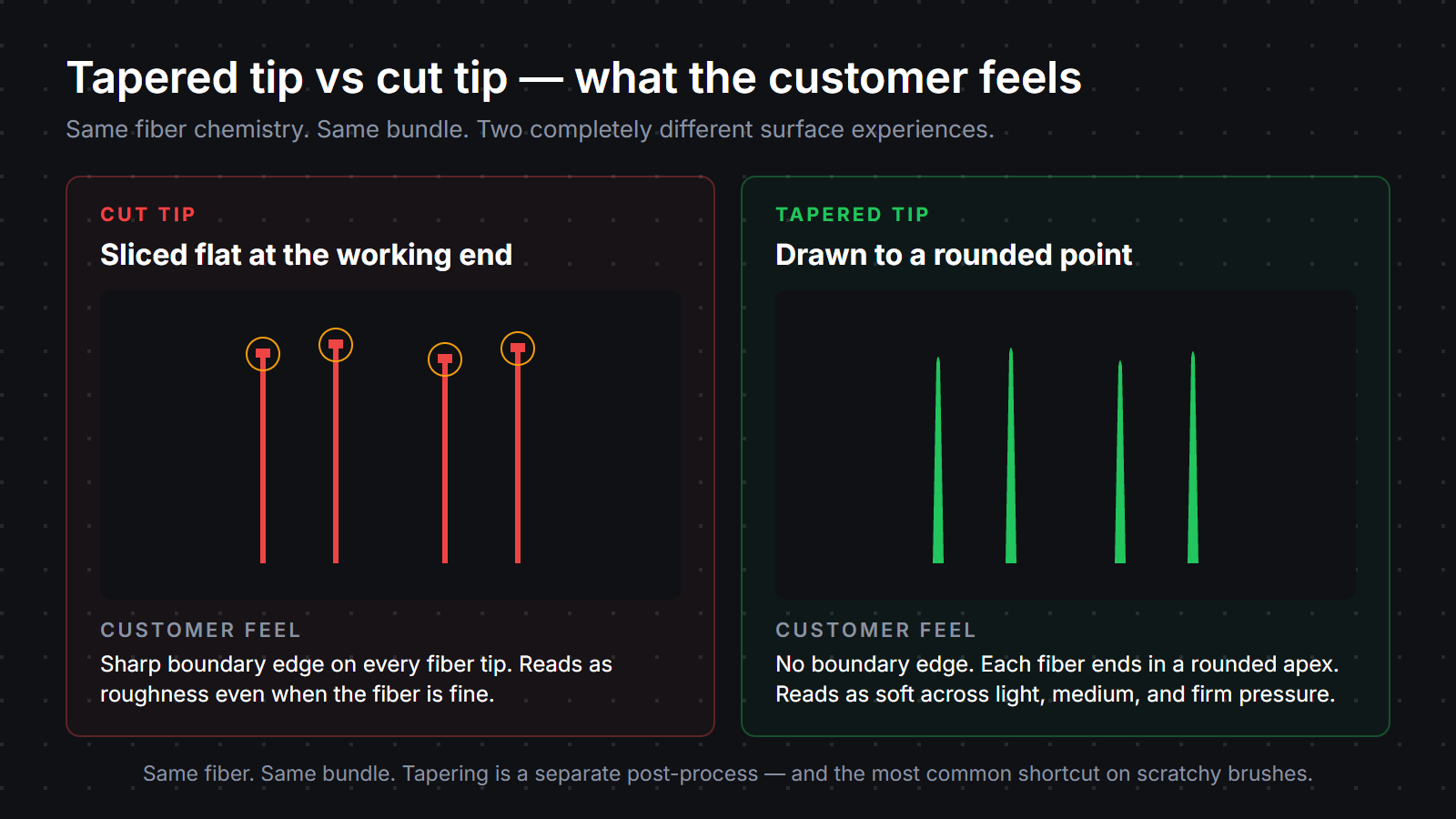
The softness a customer feels has very little to do with how thick the bundle looks or how dense the bristles are packed. It is set by the geometry of the individual fiber tip — the part of the bristle that actually touches skin — and the smoothness of the fiber along its length.
A premium synthetic fiber under high magnification looks like a smooth, gently tapering cylinder ending in a rounded point. The fiber surface is polished, the tip has no sharp boundary edge, and adjacent fibers are matched closely enough in dimension that the customer’s skin reads them as a uniform field rather than as individual points.
A scratchy fiber under the same magnification shows the opposite: rough surface texture, sharp tip edges from a flat cut, taper that ends abruptly partway down the fiber, and dimensional inconsistency between fibers in the same bundle. Each one of those four flaws can come from a different production step. A brush can fail on one of them and still ship looking identical to a brush that passed all four.
The good news for brands: every cause is preventable. The bad news: most of them are invisible without magnification, which is why so many brushes pass visual sample approval and arrive scratchy in bulk.
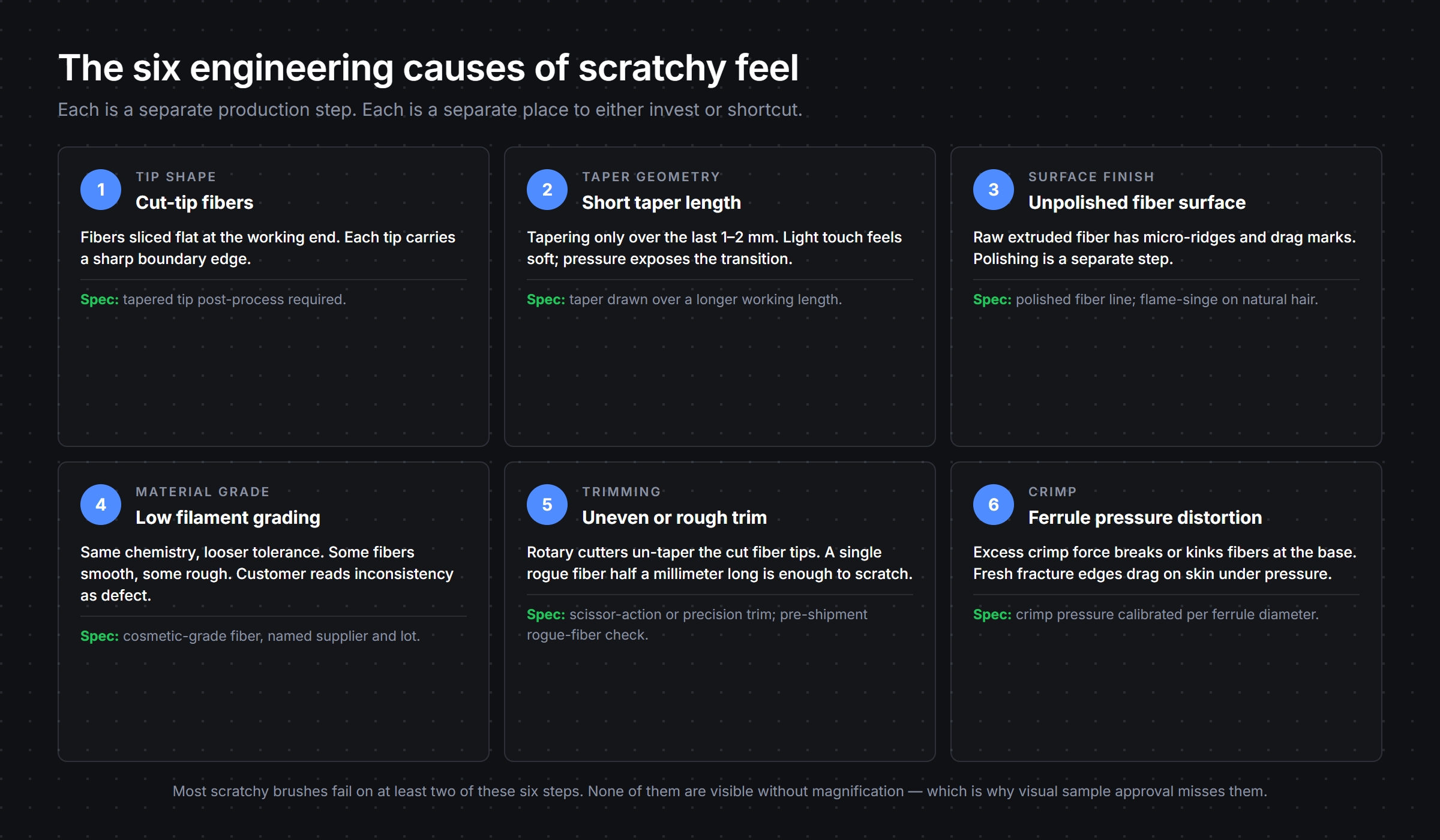
These are the failure modes we trace to most often when a brand reports a scratchy bulk run. They are in rough order of frequency.
Synthetic fibers come off the extrusion line as uniform cylinders with flat-cut ends. A flat-cut fiber tip is mathematically a small ring with sharp boundary edges — under magnification, it looks like a tiny pipe end. Drag that across skin and the edges register as roughness, even though the fiber itself is fine.
A tapered tip is a separate post-process. The fibers go through a tapering treatment — typically chemical or mechanical — that draws each individual fiber to a point. The result is a fiber that ends in a rounded apex with no boundary edge.
Tapered tip processing adds production cost. It is one of the most common shortcuts on lower-priced brushes, and it is also the single most common cause of scratchy feel. A brand that asks an OEM makeup brush factory for “soft synthetic” without specifying tapered tips can get back a cut-tip bundle that technically meets the spec and reads as scratchy on every customer review.
Even tapered fibers can be tapered badly. A short taper means the fiber narrows only over the last small portion of its length — perhaps a millimeter or two — with the rest of the fiber holding full diameter. The customer’s skin meets the soft tapered apex first, but as the brush presses or sweeps, the transition zone from taper to full diameter registers as a sudden roughness.
Premium tapering processes draw the fiber to a point over a longer working length. The transition is gradual, the tip feels uniformly soft across light, medium, and firm pressure, and the customer reads the brush as “consistently soft.”
This is the variable brand sample approvals miss most often, because a short-taper brush feels soft on initial light touch and rough only when the customer applies the kind of pressure they actually use to apply foundation.
Raw extruded synthetic fiber has surface roughness at the microscale. The cylinder is not perfectly smooth — small ridges, drag marks from the extrusion die, and surface micro-irregularities are normal coming off the line. On a high-grade fiber, these are removed in a post-extrusion polishing step that smooths the surface to a near-uniform finish.
On a lower-grade fiber, polishing is skipped or shortened. The fiber tip might still be tapered, the bundle might still be dense, but every individual fiber’s surface texture is contributing to a low-grade scratchy feel along the working length.
Natural hair has its own version of this problem. Premium natural-hair brushes use a flame-singeing or smoothing process to round the cuticle tips after cutting. Skipping this step leaves the natural hair with the sharp cut edge the customer feels under pressure.
Factory Note
Fiber surface polishing is the single least-discussed step in brush engineering and one of the most expensive to do well. Two brushes spec’d identically — same density, same taper, same fiber type — can feel completely different if one of them came off a polished line and the other did not.
Industrial synthetic fiber is sold by grade. Cosmetic grade has tighter tolerance on diameter consistency, surface finish, and taper geometry. Cleaning-product grade and paint-brush grade share the same chemistry (PBT, PET, polyester blend) but allow looser tolerances on every variable.
A bundle made from low-grade fiber will contain some fibers that meet cosmetic spec and others that do not. The customer’s skin experiences this as inconsistency — a brush that has soft spots and rough spots in the same stroke. It is more annoying to use than a brush that is uniformly rough, because the inconsistency itself becomes the perceived defect.
The factory cost difference between cosmetic-grade and lower-grade fiber on a per-brush basis is small. The cost difference in customer reviews is large.
After bundling and crimping, the brush is trimmed to its final shape. The trimming step removes excess fiber length and shapes the working surface — domed, flat, tapered, or fan-shaped. Trimming method matters more than most brand briefs acknowledge.
Cheap trimming uses a rotary cutter that leaves a slightly sharp edge on every cut fiber tip — even fibers that had been tapered originally. The trimmer essentially un-tapers the very tips it cuts through. Premium trimming uses a scissor-action mechanism or a precision cut that minimizes the cut-edge sharpness.
There is also the issue of trim consistency. A poorly maintained trimmer leaves the occasional fiber slightly long — and a single rogue fiber, sticking out half a millimeter beyond its neighbors, is enough for a customer to feel the brush as scratchy even when the other ten thousand fibers in the bundle are perfect.
The ferrule crimp holds the bundle to the handle. Crimp pressure has to be tight enough to prevent shedding and loose enough to leave the bundle geometry intact. Set it wrong on the high side and the bundle deforms.
What deformation looks like in practice: fibers near the crimp boundary kink, break, or splay outward. Broken fibers have a fresh sharp edge at the break point. Kinked fibers angle slightly off-axis and present an edge to the working surface that was never meant to touch skin. Splayed fibers spread the bundle wider than designed and cause the outer ring of the working surface to drag.
The customer experiences all three as scratchy feel near the base of the bristles — the part of the brush that contacts skin during firm pressure. The damage happens at the ferrule but the symptom shows up at the working tip.
Factory Note
Ferrule crimp pressure is calibrated per ferrule diameter and per fiber bundle weight. A correctly crimped brush at 25mm uses different pressure than the same crimp profile on a 12mm eye brush. When a factory uses one pressure setting across all sizes to save tooling change time, the smaller brushes in the line are the ones that turn up scratchy first.

Visual sample approval will not catch most of these failures. Three practical tests cover the gap.
The wrist back-test. The back of the wrist is more sensitive than the back of the hand and approximates facial-skin sensitivity better than the palm. Sweep each sample brush across the back of the wrist with light, medium, and firm pressure. A brush that feels soft only on light pressure is hiding a short-taper or cut-tip problem.
The dry test, then the wet test. Wash three samples per SKU and let them air-dry on a clean surface. Re-test the back-of-wrist sweep after drying. If the brush feels rougher after washing, the unpolished-fiber or low-grade-filament problem is in play — the wash partially exposes fiber surface texture that was masked by factory sizing or handling.
The rogue-fiber check. Hold each sample brush against a single sheet of white paper at the angle a customer would hold it during application. Sweep gently. Single fibers sticking out beyond the bundle envelope will catch on the paper and become visible. This is a quick proxy for trimming consistency, and it catches the rogue-fiber problem before it ships.
Three tests, fifteen minutes per sample SKU. The brands running them routinely catch defects that ship out of factories who do not.
We see the same misunderstandings about scratchy feel across brand briefs almost every quarter.
Asking for “soft” without specifying the engineering parameters. A brief that says “soft synthetic, premium feel” gives the factory zero technical instruction. Specify tapered tips, taper length, polishing, and fiber grade in the spec sheet — and ask the factory to confirm each one in writing. “Soft” is a perception. The four parameters are how that perception is built.
Approving a sample on light touch only. A sample tested by lightly stroking the back of the hand is not a real-world use test. Customers apply foundation with firm pressure. They blend with circular motion. They press the brush flat against the face. Test the way the customer will use the brush.
Assuming a custom makeup brush manufacturer that “feels right” on one program will feel right on every program. A factory’s tapering capability on a face brush does not necessarily transfer to an eye brush at a smaller diameter. Different bundle sizes, different crimp pressures, different fiber lots. Test scratchiness per SKU, not per supplier.
Confusing density with softness. A dense brush feels firm under pressure even when individual fibers are soft. Brands sometimes interpret firmness as scratchiness and ask the factory to “make it softer,” when the actual fix is to either tune density or accept that the brush is the right tool for its job. Our walkthrough on scoping a private label brush line covers the density-and-formula decisions that surround this. Cross-component finish issues — including the anodized ferrule color drift that often shows up in parallel with fiber problems — get separate treatment in our ferrule color guide.
Saving cost on the wrong step. The cost difference between tapered-and-polished and cut-and-unpolished, per brush, is small at scale. The cost difference in returns, refunds, and one-star reviews is large. Most scratchy bulk runs we see across the industry were saving pennies on a step that should not have been cut.
The brands that ship soft brushes consistently do two things differently. They spec the post-processing in writing on the kickoff call, and they test under realistic pressure during sampling. Neither is glamorous. Both are decisive.
The brands that ship scratchy brushes are usually not the ones with bad supplier relationships. They are the ones who treated “soft” as a brief instruction rather than as a stack of engineering decisions, and who approved samples in conditions that did not match how their customers actually use the product.
Softness is not a marketing claim a brand can choose to make. It is a manufacturing outcome a brand has to engineer. The factories that understand the difference are the ones whose brushes still feel premium on month six. The factories that do not are the ones whose customers learn that “soft” was a word, not a property. It’s one of the construction traits behind what decides makeup brush quality over the long run.
Because perceived softness is set by the fiber tip geometry and surface finish, not by the bundle’s appearance. A brush can have a beautiful dense bundle and still scratch if the individual fiber tips are cut flat instead of tapered, or if the fiber surface was not polished after extrusion.
Cut-tip fibers are sliced flat at the working end, leaving small ring-shaped sharp edges on every fiber tip. Tapered tips go through a post-process that draws each fiber to a rounded point, eliminating the boundary edge. Tapered processing costs more, and it is the most common shortcut on lower-priced makeup brushes.
Usually short taper length. The fiber tapers only over the last millimeter or two before reverting to full diameter. Light pressure only contacts the soft tip; firm pressure pushes past the taper into the rougher transition zone. Premium tapering processes draw the taper over a longer working length so the brush stays soft under real use.
Three quick tests. Sweep each sample across the back of the wrist at light, medium, and firm pressure. Wash the samples and re-test after drying — washing exposes unpolished fiber texture. And sweep the bristles against white paper to spot rogue fibers from uneven trimming. Fifteen minutes per SKU catches most defects.
Because the hair cuticle was not finished after cutting. Premium natural-hair brushes use a flame-singeing or smoothing process to round the cuticle tip after trimming. Skipping that step leaves the cut cuticle edge exposed, which the customer feels as roughness under any meaningful pressure.
Density and softness are independent. A dense brush is firm under pressure even when individual fibers are soft, which brands sometimes misread as scratchy. Real scratchiness is a fiber-tip or fiber-surface problem, not a density problem. Tune density to the product formula; tune softness through fiber engineering.
